Showing posts with label London. Show all posts

Thursday, October 26, 2017

dundee arms, formerly aka foo fighters arms, formerly aka dundee arms

22 Sept. 2017

Dundee Arms. Thursday night, 11PM. A pub stood here for as long as anyone can remember. Over the past week, Foo Fighters (yes, the band) took over the pub and made it Foo Fighters Arms, a pop-up band pub. The band didn’t turn up but thousands of fans did, every single hour of every day of the week.

About a few hours ago, all the shenanigans have ended. I’m sat inside, hearing Ritchie Blackmore rip his riffs. A young couple asks for pints of Session IPA — pointing at the blue cans in the fridge behind the bar, she claims her stepfather loved that particular brand of beer. The bartender advises they go to the nearest off-license to buy some. She repeats directions given to her, an American pronunciation of “Bethnal Green Tube stop” sounds friendly out of place.

A group of long, curly, blonde haired dudes walk in. They’re not Deep Purple (who’re not blonde) and they’re asking for a club nearby. Strangely out of the era their looks represent.

A shy boy walks up to the bar and asks for a pint of “the Roadie”; my choice of IPA. I’ve always gone for roadies.

A man walks up and asks whether I’m writing a book. I tell him I’m writing semi-fictitious stuff. That I’m making up some of the stuff that I have or have not seen — as I’m typing it.

I gave the last new, Jane Austen £10 note I had in my wallet to the bartender. Why Foo Fighters didn’t turn up for their pop-up bar is because there’s no back door entry to the pub. Crowd mitigation out of order. It would be appropriate if the music mixer behind a bricked cubicle (with a massive TV overhead, probably showing rugby games on the weekends) queued up The Doors’ Back Door Man.

A man walks up to the bar with a bunch of brochures in his hands. He’s told Foo Fighters Arms is over. It sounds like a whole musical genre has been proclaimed over in a 90’s rock’n’roll roadie movie. I take the final sip of from my pint of The Roadie.

An Irish sounding girl walks up to the bar — she’s recently moved to London. A Celtic sounding folk tune is heard over on the stereo. My flatmate texts he can’t make it as he’s too tired while I get my 2nd pint served. Since each sip continues to taste like I’m chewing on a small branch of weed must mean it’s not the glass, it’s the actual drink.

Of the three blondes who’ve just walked in, one asked for red wine, another for a Corona (keeps the slice of lime intact) and the final one a prosecco. That’s what I call diversity; bar the equally standardised hair dying operation in place.

The very important information that they’ll close at 12:45AM relayed to me may be a curse or a blessing in disguise. I need to leave home at around 03:30 for my flight to Denmark.

The journey to the bathroom is a peculiar one: as I walk away from the dimmed Art Deco lighting up the Victorian stairs into an empty hall, the last thing that would cross my mind is to run into a group of Icelandic and British birthday crowd who took over my stool. Only one of the three Icanders isn’t shaven headed but they all smell of lavender amd sweat.

A dude was complaining in the toilets that someone walked out having not washed his hands. He claimed his OCD got the better of him. He proclaimed: “why not wash your hands? It’s free!”

The Icelandic crew are slightly disappointed no pastice is served. The sambuca alternative does not cut it.

The long anticipated Old Fashioned is ready. The dude who’s kindly asked for permission to ‘borrow my stool’ had long gone and once the Icelanders have left, I’m back on my stool. The noise level has gone up by a few notches and Nirvana is on stereo.

The more I write and observe, the more I get counter-observed. Is it the recently acquired self-proclaimed author’s gaze I’m receiving reactions to or is it just it’s getting very crowded?

I get wrongly served a pint of soda after I’d gotten served a G&T, by the same man. First single malt request comes in just as a super-oriental Rock The Casbah cover kicks into the stereos as the Black Rebel Motorcycle Club crew (had appeared while I was in the loo) go mad.

A super drunk local dude asks me about lagers.

Half an hour later.. suspecting his accent and acquainting all the while, he turns out a Mancunian. Construction, Principal Tower, the Queen, pension age, Spain, Montenegro, his daughters and family, 3AM shifts, are amongst 100s of stuff we talk about.

He’s missing few teeth. He rolls his o’s to u’s as a proper Northerner. He’s baffled to hear I’m Turkish. He’s obsessed with Spain. He only took a week off in the past 3 years. He doesn’t like the fancy lager offered on tap.

He hits up on one of the 3 Corona, Prosecco, Wine blondes and I’m relieved. I’m relieved I can write again. I’m relieved he subscribes to the standard — so, my prejudiced observsation stacks up. Shame on me. Shame on whom? They’re almost kissing and I couldn’t care a tiny less. But he’s cool. He’s a Danny Boyle character that didn’t make the silver screen.

He is hating his Camden Hells. He was here all along for Amstel. I’ve got 3 more hours to waste. A direct reverse correlation between alcohol level and striving to keep awake will play against me. Where do I cut it?

The blonde approached by my Mancunian takes up on the OCD guy. He runs away. She asks me how to get back to the bar. Her lips might exlpode. An Icelander walks past. I’m worried about my flight. The stomping on the timber stairs is mixed with vanilla. Vanilla came apparently from our Mancunian’s e-cigarette. So much for the pension scheme.

Nirvana’s on again. Smells Like Teen Spirit.
Feels like teen years.
Feels like I’m done.
This is Dundee Arms.
It’s 00:44.
London’s a tough place.
It’s not been easy.
I love London.

Sunday, January 08, 2017

Here comes the piss truck

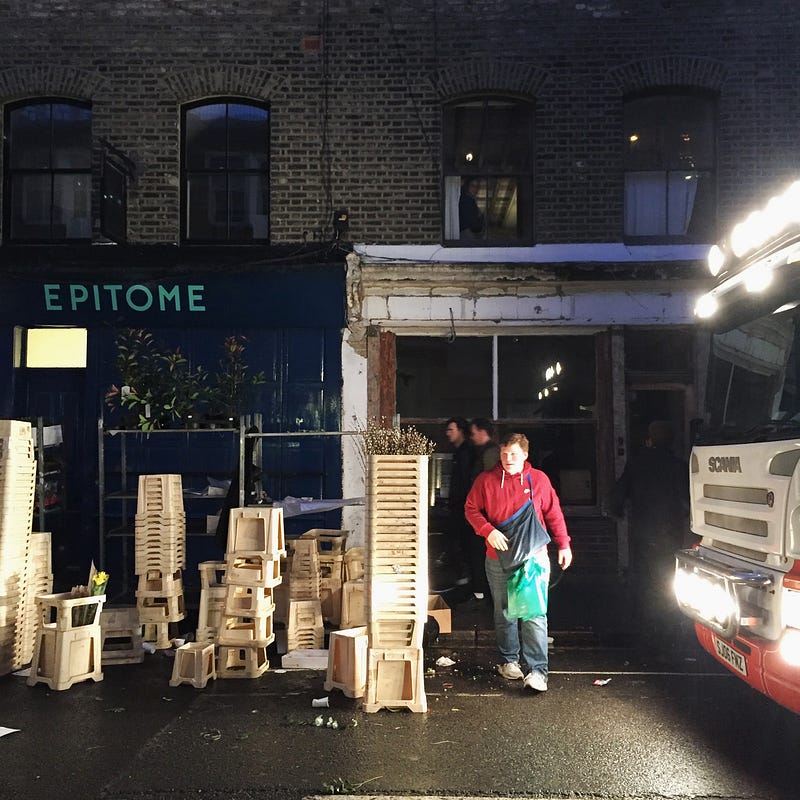
“Here comes the piss truck” they were yelling and laughing. I don’t know why they call it that, but its arrival felt like a regular proceeding to the end of another working day for the Columbia Road Flower Market. Street markets are strange, in the sense that they have a single day working week; albeit an intense one at that.

Stranger is the three-sided football league we play in. A single, two-hour endeavour, first Sunday of each month. Less stranger is ‘planned engineering works’ that take place across various public transport infrastructure networks of London. Which is why, I had to cycle on a city bike to Tower Bridge, and run to New Cross thereafter, courtesy of my bike’s broken pedal and the festive period that prevented a quick fix.

That stretch of South London on any given Sunday is primarily home to communities of Afro-Caribbean origin who stroll between their homes and those of their relatives and their local centres of religious affairs. Congregations in front of brickwork, concrete or makeshift churches, Victorian, postwar, or semi-urban houses are celebrations of colour and glamour.

Running on a side street somewhere between South Bermondsey and Surrey Quays, I came across a lady, all dressed in white except for her golden necklace and the grey earphone through which she was euphorically talking to a relative. Her posture could not have been any calmer, though. She was taking small and calculated steps and owned the very pavement we shared for those few seconds. She smelled of summer; the streets smelled of River Thames’s low tide. By the time it reaches London, the river picks up some salt and it was this indistinct trace of smell of salt that was helping my head keep clear.

The game went well; we did a good job. It’s now 3 games without a loss; a straight out win, followed by two winning draws. We jumped on the unreliable Overground on the way back, which was now running a more regular service. I took my usual route from the station but instead of cutting directly across to my street, my feet dragged me across Columbia Road (next street up) to see the market day come to its conclusion. Only few more stalls were up, and there has been carnage of flowers; those that did not make the cut and were not walked home by young couples and aspiring flatmates.
A very loud truck started its engine and started rolling up the street. When it finally stopped before the last stall standing with a loud roar, the driver jumped out to the yells and laughs of the traders. They called it the ‘piss truck’. Another week had just ended with little out of the ordinary. The ‘piss truck’ was about to start its duty of sweeping away the end of the week as I hastily, but calmly, took this picture.

Monday, April 25, 2016

Collecting evidence on Old Street cycle-lane and cycle-spaces


Many of you may have seen the roadworks around Shoreditch that lasted a good few months. A lot of enhancements have been made to separate bicycle traffic and stopping positions (around traffic lights) from motor vehicles and pedestrians who extensively use the crossing at Old Street and Great Eastern Street junctions. I pass by the area almost daily, either to commute to work or recreationally as I live nearby. A lof of time and money have bern invested, and the outcome, notwithstanding some design problems (i.e. moving pedestrian crossing further north of the bike crossing is confusing, although understandable given the cycling route via Pitfield Street), is quite successful.
You've also seen me sharing articles and personal thoughts on negotiation of right of way and traffic duties between various road users and perceptions different types of users have on one another. My general thoughts can be summarised as: "a lot of cyclists put a bad name into cycling through careless and selfish rule breaking while many (but a minority of) motor users, primarily motorcyclists, black cabs and white vans are outright disrespectful.
I was just cycling from Bethnal Green to Holborn and saw a black cab pull into the newly painted bicycle box on the left hand lane, slightly further up than the demarcation line on the right hand line to allow cyclists a crucial head start in conjunction with the all new bicycle traffic green light that goes few seconds before cars, a phenomenon new to London but one I was already used to from my times in Denmark and Germany a whole decade ago (thanks for slowly catching up London!) at what is a very busy road junction.
I waved at the driver and signalled he should be waiting at the line before the box. I know from previous experiences and common sende that it is not required of them to do so if they got stuck there whilst on the move from a previous green light. I've also sadly come to accpet deivers turning left do not need to wait for a bicycle on their rear mirror while this was a major offence on Danish traffic and having been on both ends of the stick (a cyclist and a car-driving pizza delivery boy) in Dennark, I saw how important it was... only to see it as a fantasy here. Anyhow, deliberate trespass of bicycle boxes is a serious offence which motorcylists commit all the time and get away with. This black cabbie should have known better.
And knew he did -- his blunt response to me was: "well I'm suprised you didn't contravene like all your mates do!" My calculated response for which I only had a few seconds to devise was to advise him to not be prejudiced and that two wrongs don't make a right. To which, he responded by saying "it's not prejudice, if majority of cyclists do not follow the Highway Code".
The articles and thoughts I'd shared before all signal at the same direction: road users do not trust one another, and both pedestrians and motorised users have less of a favourable opinion about cyclists. Even would-be cyclists suffer from this as they feel the roads are too dangerous, perhaps not necessarily implying potentially hostile behaviour against them but clearly observing the chaos with which the London roads operate. A lot of this bad name has been bestowed upon cyclists by their own attitudes, and this is not limited to contravening red light and annoying both drivers and pedestrians but also disrespecting zebra crossings and just foul attitude towards cyclists altogether.
I was surprised to see, how in Berlin, cyclists take liberty in facilitating pavements and disobey traffic lights -- an argument often put forth by anti-red-light coalition of cyclists in London as 'those rules are made for drivers and cyclists are incentivised to take shortcuts or streamline traffic'. Well, the truth could not be further from it, and for a number of reasons, including but not limited to: the very different cultures of negotiation between road users in the UK and in Germany; the very different road infrastructures (compare London's mainly narrow streets and pavements to Berlin's wide avenues and pavements) and the sheer population density and moving patterns. Despite my limited knowledge of the discussions taking place in Germany, I think they need to debate their negotiations, too, as once I started cycling regularly in Berlin in 2013, having had lived and cycled in London for over 6 years, I found it confusing and challenging.
But that aside, the divide widens and the problem aggravates in a city like London where cycling numbers are going up and the infrastructure is barely keeping apace. In the hierarchical order of risk to road users, it is natural that the cab driver's behaviour and excuse is beyond proportionality. Yet, the responsibility is shared. The reality is his views won't change overnight by simply getting asked by cyclists to respect the demarcation lines. My intervention seemed to help, though, as he stood right before the bicycle box at the next traffic lights where I gave him a thumbs up. It certainly did not help to see careless cyclists crossing red light (one very fast and at a time when pedestrian lights turned green) on the other side of the road, though. The cabbie might have even asked himself why I wasn't picking on and shouting across the road to the other cyclists.
Although the repercussions will vary significantly, the multi-layered responses should be clear and work in parallel: (unfortunately, and as I hate to advocate this) implementation of law should be stricter; all road users should be much better informed and this could easily be facilitated by signage campaigns at traffic lights (just as is being done on buses and other vehicles); road infrastructure should certainly be upgraded faster; and regressive policies, against which I loudly advocated, such as Boris Johnson's move to allow motorcyclists use bus lanes should be reversed as it settled in a culture of motorcyclists continuously growing an unchecked level of self-confidence in breaking the rules.
To put it in the shortest and bluntest way possible: we all have to be a lot less selfish and a lot more selfless.

Thursday, March 17, 2016

lucid disguise


Of all the possible juxtapositions in this part of #eastend this has always intrigued me the greatest: 

In the foreground is Carter House of Holland Estate by East End Homes in #spitalfields, a typical 1930s social housing estate, home to a large Bangladeshi community who has made large parts of#bricklane what it is today (on that note: brick lane has been a street of constant transformation over the past century and a half, something that's got frequently missed out on the anarchists vs. cereal-maker gentrifiers debate last year). In the background is the Nido Building functioning primarily as a private student accommodation unit. In any other context, a building whose architectural style I find more appealing than other people may, its cladding and dominant blue hue convey to me a false interpretation openness and transparency.

Both estates/buildings are located within the borough of Tower Hamlets, where its edge with the City of London is defined by Middlesex Street, right beside, to the west of Nido Building. The borough council's revenues from Nido's development may even have helped preserve and maintain Holland Estate to date, although we know there is an imminent threat of destruction to pave way for a new development. 

This is a site that sits right in between recently developed, tourist-attracting Spitalfields, developing and startup/incubation promoting, Norton Folgate, rapidly changing, looks-more-like-Manhattan neighbourhood of Aldgate and of course, the behemoth that is the City of London. All of these areas historically, as well as economically established and diverse, naturally prone to phases of structural transformation. #cutlerstreet #clothierstreet existing and transformed (Discount Suit Company) textile and fashion stores are all reminiscent of the huge legacy of this particular site of East End. No wonder why, of course, the pedestrian footfall on #brunestreet where this photo is taken is almost zero while city workers, students, walking tours, lunch breakers flock to arteries and avenues nearby.

Yet in the middle of this mish-mash, what stands out for me is how Nido Building's almost curtain/wall-like shape cuts Holland Estate from the rest of its surroundings in a way no other block of buildings are so visually overshadowed by other City towers that are architecturally so much more forthcoming and eye-catching, such as the Gherkin or Heron Tower just further south. You could argue that this wall protects Holland Estate in a symbolism representative of urban walls we know of our recent past, be it the Berlin Wall, Iron Curtain or the Western Wall. And for that reason, like all other walls before and after it, to me it represents a threat and a cursing in not so much disguise...

Sunday, February 08, 2015

But Capitalism is Realism

I got to learn to love Rothko. I was taught to appreciate Beuys, Baselitz, Balthus. I am not sure if the letter B was a coincidence but it wasn't difficult to fall in love with Bauhaus anyway. I always had a thing for orderly shaped structures. In my first ever visit to Berlin in a cold August day in 2005, the Bauhaus Archiv was amongst my first stops, along with Neuenationalgallerie. The efficient linear geometry must have appealed to what my friends regard as my highly analytical mindset. In Turkish, there are a few sayings on people with perfectly "cornered" (or rather right-angled) attitude/mindset/life view -- they are a bit "thick". And so was I, perhaps. That is why Kandinsky came along rather easy, and so did Malevich (and I am sure this is blasphemous).

In any case, this is not about throwing in some major 20th century modernist artists names out there to prove a point. It is about the feelings and thoughts that crossed my way today when I went to see the Sigmar Polke exhibition at Tate Modern, on its penultimate day. It wasn't a perfectly planned day and in fact I had no intention to see the exhibition. A former opportunity I had with Z. was quickly replaced by heavy indulgence in cheese and wine at Gordon's Wine Bar. The exhibition's posters had not appealed to us (and in fact, I now think they are poor representations of the contents of the exhibition) and I for one, had almost no information on Polke and his work. Maybe I'd heard his name in passing in one of those Uni. courses where I was taught to appreciate everything Beuys had to offer to the world -- Beuys, whose disciples (and amongst his fierce critics) included Polke himself, of course.

Today's programme came out of the blue, as well -- or rather out of my wardrobe necessities. If the Argos branch in the Cannon Street Underground Station (yes, there is an Argos on the Underground/Rail Station, which I believe is a good way of utilising some spare storage space) wasn't the only Argos in the vicinity to keep some much-needed wooden hangers in stock, I would have never gotten to write any of this. When my flatmate O. said he'd go see the Polke show and enjoy some fish & chips near Waterloo, I could not think of a better scenario in which I could burn some much needed post-battered cod calories one a journey on the bicycle back via Cannon St. where I could also pick my hangers up... Little did I know, I'd end up indulging myself in deconstructing my own myths on the superiority of the post-war artistic movements, including American take on abstract expressionism, which of course followed from my deepest appreciation of the modernist arts and design movements, at the core of which sat the inter-war period preceding, but not necessarily rendered irrelevant for Polke's references. Wasn't it at Tate Modern, some years ago, I saw works of Otto Dix and others and re-established for the xth time that times of hardships bring about some of the most sincere and sensical pieces of art --- well, all generalisations aside, Polke's 1960s welfare, baby-boomer, West German fuelled art came as a slight refreshment and a cure to a stomach consumed by deep-fried crisp.


There are a few benefits to studying history and sociology for four years: you know (to some extent) what happened at certain periods of time in certain parts of the world and you can most often find discourses, trends, contexts to link things with one another -- especially if you are a bit "thick" like I am. So, it is of little wonder that I usually enjoy the contextual framework of major art exhibitions the most, and there is as much context as there is history. With some decent descriptive guidance, it is very easy to appease me with any exhibition Tate Modern would put together. 

After that due introduction, I should strive to explain why what I got out of Polke's work was still so significant in its own right: First of all, what I learn from Tate Modern's description of Polke's work and its carefully curated sections that include one on "Modern Art" where he criticises the works of Malevich, Pollock, and the American Pop Art, yet by utilising some of their distinctive forms (and at this point, I have no other guidance into Polke's thinking than what I am reading on the descriptions at the exhibition and what I am seeing), is at least a challenge to some of the artistic values I have been taught to appreciate. Moreover, perhaps, it is one of those great intra-art-scene playfulness that these "great artists" played amongst themselves. Polke, to being with, is hardly outside the establishment, something neither he nor the exhibition has any attempt to disguise. It is his critical approach to what he is dispensed at Kunstakademie Düsseldorf that creates the much celebrated artistic figure by the end of the 1960s. And it is this celebration, amongst what the dawning of the post-war West German society brings to convenience his later departures from the urban, from the mundane, and towards the spiritual (by way of experimentation of drugs, of course).

Polke's subtle but unsettling relationship with his predecessors and contemporaries and some of my "artistic heroes" is at first satirical. Ridiculing the African interest in early modernist painting, undermining the t-square is all entertaining and provocative but, as can be expected, Polke is very much moved by the very tools of the great works and he is no short of implementing similar methodologies both during his earlier and later years. What is most impressive is his experimentation with new methods -- whether that be unique materials deployed on his canvases, or the break away from the standard canvas as we know it -- yet Polke's outputs, as compared to his contemporaries has but got the thinnest boundaries to tell them apart.


The crux of my unexpected date with Polke is how I seemed to find myself appreciate the methodologically subtle but visually strong response Polke had to his contemporaries, which, in turn becomes his own undoing. Polke, in my opinion, is another one of those great post-modern artists before the dawn of post-modernity and is a great modernist long after modern movements (as we know them, in this geography) have been abandoned. Not that Polke has any claim to any of these entitlements anyway (my information is solely based on information boards and the curation with which I am made to appreciate his work) -- the artist seems to have successfully avoided unnecessary publicity.

What is left, then, is all the emotions one goes through when you see the progression from his small-scale drawings and sketches of the early 1960s, to reach levels of certain transcendence in 1970s and depiction of paths beaten to Afghanistan and Pakistan and engagements with peoples and produce of a new geography and semi-experimental videos to gigantic canvases spanning East-West German borders to Papua New Guinea. And as personal as they are, how I took in all of that is much harder to describe and share --- for all I know, the more accommodating I become in my own fallacies, the wider the spectrum becomes. Polke certainly gave me a good nudge with that.


Tuesday, November 06, 2012

Remember, remember, the salt and vinegar

It has just past midnight now. Antony is mellowly singing Swanlights into my ears. The flutes and the violins beneath the noise cancelling headphones are overrid by the sound of fireworks setting off in the background, for the Guy Fawkes' Night. British are blowing things up to celebrate an event that avoided the blowing up of the Parliament, as a friend noted wittily.

There is a bitter chill -- it is just a couple of degrees above freezing temperature, but it is kind of warm inside me. A young couple walk past me towards the pub at the junction of St. John Street and Percival Street. The girl is drunk. I wonder what she thought when she saw the wedding gowns on display at the fashion store next to the pub, as she held tight on to the arms of the tall boy. By tall, I mean British standard. By short, I would mean myself.

I am dragging my good, old road companion, the red Raleigh bicycle. Four and a half years on and it has not let me down. It is in such poor condition that noone bothers to steal it, or parts thereof. It is in such decent condition that I happily ride it as the wind blows through my hair and the lack thereof and next to. I hope I did not jynx the good fortunes of my Raleigh and me.

It is a rather bizarre coincidence but as I was leaving the building I work in, I ran into a student that is in the Master's programme affiliated with our centre, the programme I completed in 2008. We walked up Kingsway and a bit of Theobald's Road before she turned into Lamb's Conduit Street towards her direction home. She told me she is from Raleigh, North Carolina. I only realised this coincidence as I type these.

So, I stopped at the corner of Central Street, to see if I get a glimpse of any firework excitement. I was hoping for a few drunken fireworks that would skirt around the Barbican and the Shard in the background. I wouldn't mind if it hit the construction of the Walkie Talkie, as long as it does not harm any workers that may be on site now, physically and economically, that is. Much to my avail, the festivities of the night already stopped and the ugly Walkie Talkie gets away with it this time. The notorius British safety rules and regulations must have come to its help.

All I want is a box of chips with salt and vinegar right now. Well, and an Old Fashioned would do nicely, too. I gues I will give the local fried chicken store its long awaited chance -- the shop owner won't be too happy when I go only for fries, I don't know how the chicken will feel. And at home, we've got some new whiskey. I think it is blended Scotch, and it will be a waste to substitute for a bourbon, but who can tell the difference when stuffed in their mouth with chips with salt and vinegar?

A delivery truck just drove by and dropped a large white box. The driver made a 360 turn, metres ahead and came back to pick it up. It must be a valuable piece -- shame I was too slow to investigate further. I am always slow in cutting corners short. But, well I better cut the next corner soon, before my fingers and toes freeze, and before the fellow chickens close for the night. At least, by now, my flatmate must be asleep, so he won't mind my greasy fingers on his whiskey bottle. Cheers to him!

Saturday, June 09, 2012

a weather warning

There is that distinct smell out there tonight. My awareness of it does not necessarily stem from the consistent weather warnings they had during the day regarding strong breeze, heavy winds..

Every city has one of its own. London's got that one with a mix of yeast, piss, greenery, deity, piety, prosperity...

I am on a side street off of Theobald's Rd.

There are not many side streets of such relative insignificance off of Theobald's Rd. Most of the streets lead to somewhere significant... that's the cost of being a major thoroughfare in central London. Your branches lead off to somewhere of such significance that either the pavements are too wide (which means many pedestrians will walk through there at the dark of the night) or that the roads are 2+ lanes; and in either case, that's not a street you would want to take an emergency piss on..

but this one here, called King's Mews is a particularly narrow one...

there are houses with fake, freshly white painted colonnades...

the small alleyway leads to a wider street. It is a common makeshift adaptive English planning heritage but it reminds me of the ad hoc street typologies created in modern Istanbul.

I feel like I am walking through a street in Bomonti. A Jewish cemetery left of me, an Armenian school to the right, an off-license straight ahead, a transvestite across the road --- all, a travesty of urbanity...

only difference in being that I wouldn't be out on a hunt to piss on the streets in Istanbul, it never was part of my "culture" but neither were the Danish ladies I first encountered kneeling down and pissing on the spot at Roskilde.

Across from the side of King's Mews from Theobald's Road is some Inns, demarcated and boundaried by walls, the height of a 1.5 human's height (just about the size of Berlin Wall?).

Beyond there is where lawyers luncheon every day, I always cycle past it. It is always on my sight but why weren't these "sale" signs on this side of King's Mews that I see put up on abandoned buildings? There is a house under renovation with furniture scattered about, dirty white look like dead mannequins at night. These signs remind me of the Eskidji signs, green on yellow that popped in the affluent neighbourhoods of Istanbul in mid-2000s, at that time of my life when every fresh breath of breeze I inhaled smelled of identity, of urbanity, of places afar that had lived and will always live long past my life and my apprehension.

I stand next to a fake collonade....

I want to have you in my arms.

Monday, February 13, 2012

Les Misérables, Ciné Lumière and a sunday cinema double bill


 When I checked the clock, it was still very early. My eyes were unable to pick up the light outside to tell me whether the sun had already set as I woke up from a terrifying dream: a tall, blonde guy was answering all the questions correctly; with answers that I would have no idea about. He was before me in the queue, and I would be the next up. I realised I had no chance, and that is when I woke up with a cold sweat. It did not take long before I went to sleep again. When the hour finally hit 10 and I woke up to a cold and dry Sunday morning, I prayed that the actual experience would have no resemblance to what I had earlier dreamt.

It took me about 15 minutes to walk down to Barbican from my house. I had not eaten breakfast but I had no intention to get to my destination any later than I already was. I did not shave although I thought about it. I did not comb my hair, not there is much of it, but I also thought about it. I did not wear anything special, and I did not put much thought in it, anyway. By the time I got to Beech Street, I could already see the long queue, that stretched all the way from the entrance of the Guildhall School of Music and Drama, curling its way around the Barbican Centre and one of the iconic towers of the Barbican Estate. I was disappointed with myself, knowing that I should have gotten here earlier, say, at 8 AM. But to be fair to myself, I would not even have turned up for my first ever try to be an extra in a feature film, had I not met L. and Z. who told me about it yesterday; had I not gone to the cinema with M. and invited R. who ran into L. and Z. at the theatre, with whom we had lunch afterwards. By the looks of the queue, it looked as if I was not going to make it into the registration for Tom Hooper's remake of Les Misérables.


So, there were no questions or interviews in the end like those in my nightmare. But there was not much remedy in showing up a little late, neither. It was announced shortly after my arrival that already more than 2,000 people showed up and that we would have to wait up to 4 hours, with no guarantee to get inside the building. Soon after that turned into "we will issue some tickets to those of you who we believe to be unique but others will not be seen today". It was something spectacular to see such interest to be an extra for a film. To be fair, though, the production is big, its cast is ambitious and there is a £110/day to be earned over the few days of shooting that the extras would be part of. Sadly, I was not qualified as unique, and neither were L. or Z. for this film's purpose. I was less about the £110/day to be had, but more in the idea of getting a foot in a major feature film production, something that I keep on dreaming about, and looks like there will be more dreaming than reality in the foreseeable future. Ah, how I thought I would shine as an extra in one of the dreadful scenes as a prisoner or a "miserable", how I practised the day before in the company of others, only to first entertain and then annoy them, and how this would have fit perfectly next to my role at the 2012 Olympics. Well, so much for Les Misérables, we thought, as we moved on.

After a brunch with L. and Z., I decided to head to Leicester Square for a cinema double bill. It has been long time since I saw two films back to back at a cinema. In fact, it has been long since I have done it on the TV or on a computer, too, but my history with back-to-back films at the cinema go a long way. For those of you who at some point in their lives have been "festival-goers", you would know about the rituals of seeing 4 to 5 films a day with the occasional lunch, dinner, coffee breaks, hovering from one cinema theatre to another one, only to bump into celebrities, friends, and those involved with the art of cinema who are often not to be seen in social environments whatsoever for the rest of the year. I have had the privilege to experience this in Istanbul, Berlin, London (and almost in New York) over the years. Even though each city has its own characteristics, and often the events are held at different seasons (in the harsh snowy winters of Berlin to tulip-blossoming springs of Istanbul and the rain-washed autumns of London), they all have one thing in common. For the "festival-goer", the city becomes a large film set as you wonder from one scene to the another. People on the street are your own extras, and your environment is your soundtrack. These were the thoughts I had when I decided to give my lone self another go at a back-to-back cinema experience. There were two films in my list that have been at the theatres for a long time and were about to be pulled out: Hugo 3D and The Girl with the Dragon Tattoo. Luckily on unluckily, they were both playing at the Odeon Cinema at Leicester Square and at back-to-back sessions.

I started off with Hugo 3D. It was 2 PM, I was full with a nice Sunday roast and on time to avoid the early commercials and nothing could make me less happy... than the fact that Odeon was overpriced, the hall was tiny, the screen tinier, and I was sitting at the corner of the first row. It was not the 3-D glasses I wore for 2 hours that bothered me, it was rather my neck that squeaked more than the automaton featured in the film.

It was around the halfway through the film that Isabelle, the lead girl of the film, referred to Hugo, the lead boy and the character, as Jean Valjean in a reference that I cannot remember right now. If it wasn't for T. who reminded the day before that Jean Valjean was the main character of Les Misérables, I would probably have missed that funny reference. Then, after all, could the name Hugo, of the main character, be a reference to the great Victor Hugo, the author of Les Misérables? It felt as if my day with Les Misérables was not over yet. Jean Valjean did not provide the only coincidental reference to some of the conversations we had the day before with T., L. and Z. L. works for an organisation, based at the UCL who run a documentary film festival in June called "Open City". Although I did not recall this at first, now I seem to remember that we occasionally received emails from this organisation on their monthly documentary screenings while I worked at LSE Cities. There is a round of screenings for the European Documentary Festival starting at the Ciné Lumière in London on 16th of February, Thursday and there is a screening at the UCL on the 22nd.

The fact that Hugo celebrates the cinema of the late George Mèliés and therefore touches upon the history of early cinema and the Lumière Brothers was another nice coincidence linking up today and yesterday. The extraordinary visual representation of cinema of Mèliés is one aspect of Hugo that I think may win the film the Academy Award for Best Picture. In that regard, I am sure it will touch some people's hearts rather lightly like one of its competitors The Artist does. However, what makes Hugo even more extraordinary is its use of the 3D technology. I am one of those who believe that Avatar was somewhat a joke and its use of 3D was such a gimmick. I listened to many podcasts of Kermode and Mayo on BBC Radio 5 (much recommended for film lovers) over the years and got myself indulged in thinking about where I stand with the whole 3D debate in contemporary cinema. I found it very courageous of a filmmaker like Martin Scorsese to open himself to such development. I guess that what makes him one of the most celebrated directors of all time, his ever continuing appetite for progress and boy has he been successful in genres and over decades. He talks to Kermode and Mayo about how he "wants to do all his future films in 3D from now on" in one of their programmes. There is a lot to be said about Hugo but I do not want to make a full film review out of it, here and now. I just want to say I really enjoyed it, and it was yet another joyful coincidence to see Michael Stuhlbarg take part in it, the man who plays the character of spectacular Arnold Rothstein, the early 20th century and Prohibition-era mafia in what is my current favourite TV show, Boardwalk Empire. And guess who is one of the executive producers and the director of the pilot episode of the show?! None other than Mr. Martin Scorsese, himself.


The second film of the day was The Girl with the Dragon Tattoo. I was looking forward to this film for a long, long while. I have to admit I was a bit confused when I first saw the trailer to and the posters of the first of the trilogy by David Fincher's adaptation of Stieg Larsson's literature. The name of the film sounded very familiar but I could not quite make out how. I did not know of Larsson's books before hand but then I realised that films with a similar name to this had just been released a couple of years ago; these were the Swedish versions of what Hollywood then re-made. This was probably one of the fastest remakes I have ever encountered. Although it may be argued that they are not remakes but just Hollywood adaptations of the novels, as against the Swedish versions, I reckon, had there been no Swedish TV-cinema production of this literature, Hollywood may have never picked it up. There were a number of reasons why I looked so much forward this film, other than its trailer being awesome.

First of all, I am a big fan of David Fincher's cinema. I am part of a generation of youngsters for whom Fight Club and its subsequent soundtrack meant something. The film was the cinematic representation of the way in which we wanted to go through our adolescence. Although other fringely mainstream films like Requiem for a Dream would be what we would like to aspire to, were we to have artistic careers (but not the types of lives depicted in it), most of us must have thought we could end up like Tyler Durden at some point in our lives. For me, Fincher was already special with Se7en and The Game (which a lot of people underestimate, I find) and Zodiac had just put him in a special place. And I think I also liked The Social Network more than many others I know. What I find so delightful in Fincher's films, apart from the great soundtracks, the audio-visual feasts, the always-right pace (often fast, sometimes delicately slow and always a good mix of both), his appetite for peculiar characters, is that he can pretty much make a film of any story you will give him. Obviously it helps if he is feeding from a text from Aaron Sorkin, or great literature, but I think he is one of the few directors that can make you watch what is practically a legal case and make a good entertainment out of it. With The Girl with the Dragon Tattoo, he already had something fascinating to play with.

Another reason why I anticipated his take on the Swedish thriller was the Immigrant Song. Immigrant Song has been a top-20 in my playlist during my high-school years. I had given Led Zeppelin a good long break since high school, bar the summer when Robert Plant came into town (Istanbul) for the Jazz Festival I was working at, but hearing a raw Karen O (of Yeah Yeah Yeahs) take on a Trent Reznor cover of what was one of my long-time Led Zeppelin favourites clearly got me going. Should I also add here that Nine Inch Nails's dark The Great Below was a beyond-inspirational song during my early teens?


The film lived up to my expectations. I have to say that at times I felt Fincher compromised on the story's magnificence for the sake of some mainstream elements. It looks as if he gave into the Hollywood formula of making the film more approachable to wider audiences by making the characters a little more human than what they may normally be (I have to admit I have not read the books, though). Their relationships progress almost in a comical contrast to what we expect of their very strong, individual beings. Of course, with such successfully built-up violent rape and snuff scenes, the film is anything but a Sunday family outing, yet there is something in it that makes us realise we are watching a Fincher suspense thriller, but not a Gaspar Noé psychopathy. David Fincher seems to have followed, once again, his interest in dealing with complicated the state of affairs of individuals' dealing with some predominant social aspects of the societies in which they can (or cannot) operate (as he did so well with Se7en, Fight Club, or Zodiac). The fast-paced film makes for an easily followable and watchable two and a half hours of dark and wintry landscape. Some small details here and there also let the audience take a breather: I loved how the IT geek Lisbeth meets in the beginning of the film wears a NIN t-shirt, a reference to Trent Reznor who wrote the soundtrack. The entire theatre burst to loud laughter when Lisbeth was seen with her t-shirt reading "fuck you you fucking fuck" during her "morning after" enriched with the unexpected visit from Mikael, the journalist. And it did not take me too long to fall in love with the character of Lisbeth.

Fincher is one of the remaining great, mainstream filmmakers who has not yet adopted 3D into his cinema. I have not yet heard of him outrulr 3D from his future films, in the fashion that Christopher Nolan did. I have to say I agree with Nolan's reasoning of why he does not choose to use 3D, at least just yet, for the final part of his Batman: The Dark Knight trilogy. In this regard, as I said earlier, I hold Scorsese's pioneering decision and his use of the technology in high regard but for the moment, we can live with the IMAX, provided it comes with good stories, good acting and good directing. In that case, I don't even mind moving my neck right and left as if I am watching a tennis game (as against watching a bungee jumping event).

As my 4 hours and 45 minutes of double-bill cinema came to an end - and by its length, that could be 3 back-to-back films - I decided to re-fill my supplies with some "eat as much as you can" Chinatown goodies, reminiscing of my poor first year in London, doing my MSc. That was not the only thing that made me remember things, though. As I took a nice, 45-minute walk back home I re-visited the scenes from the day and from my own persona past. I traveled around Gare du Nord, making my way over the bridges over Seine, and across to the remote island in northern Sweden, then swimming down the Gulf of Bothnia to Gamla Stan in Stockholm, reminded of my "miserable" self cycling in the freezing cold in the dark winter nights in Denmark, or walking home from a long day of cinema through the prostitutes and stray cats on a spring evening in Istanbul. Yet again, the cities were my film set, devoid of extras on a late Sunday evening in London with deserted streets but I was happy to move from one scene to the next.

Sunday, January 29, 2012

Bir Kamu-Özel İştiraki: Occupy London

Cogito Dergisi'nin 69. sayısı (Kış 2011-2012) yayımlanan yazıma buradan ulaşabilirsiniz.

“En nihayetinde Occupy London hareketinin şekillendiği mekanın, hareketin yarattığı anlatı kapsamındaki önemi, siyaset ekonomisi ve sosyal hareketler merceğinde mekânsal olguların taşıdığı anlamı simgeler nitelikte.”

Arkadaşlarımın Stratford High Street üzerinde, son 5 ila 10 yıl arasında inşa edilmiş, güvenlik kodu girişli sayısız binalardan birinde verdiği yemek davetinden çıkmıs, eve dönüyordum. Evin balkonundan son rötuşları tamamlanmak üzere olan Olimpiyat Stadı ve Anish Kapoor’un 2012 Londra Olimpiyat Oyunları için The Orbit’e bakarken ev sahibiyle önceki akşam katıldığım Olimpiyat Oyunları Açılış ve Kapanış Seremonileri seçmeleri hakkında konuşuyorduk. Konu bir ara, yaklaşık 2 ay önce açıldığı günden itibaren Londra’nın bu bölgesinde yaşayanlar için önemli bir haber haline gelen Westfield Stratford City’ye geldi.

Avustralyalı dev yatırımcıların son şubesi olan bu AVM, içinde barındırdığı onlarca mağaza ve Vue Sinemaları'yla kısa sürede gözde bir mekan olmuştu. Stratford mahallesi, Birleşik Krallık genelinde ölçülen çoklu yoksunluk endeksinde en yoksun %13’lük dilimde yer alıyor. Olimpiyat Parkı Çevre Düzeni ve Yerel Kalkınma Planları uyarınca Westfield’da açılan mağazalarda çalışacak kişilerin çoğunun bölge halkı arasından seçilmesi gerektiği belirlenmişti. Şimdi bu mağazalarda çalışanların önemli bir bölümünün okuma-yazmayı mağazalarda çalışmaya başladıktan sonra aldıkları eğitimler sürecinde öğrenmelerine ise şaşırmamalı. Bölgede yaşamayan çalışanlarsa Stratford, Pudding Mill Lane, Stratford International gibi yeni açılan ya da genişletilen ulaşım ağına eklenen ve üst-yapıları geliştirilen istasyonları kullanıyordu. 1990’larda Canary Wharf’ta olduğu gibi, Londra 2012 Olimpiyatları’nda da, özel iştirakler yerel istihdamın artırılması, altyapı ve konut gibi kamu yatırımlarının tedariki gibi konularda yerel yönetimler ve merkezi hükümetle el ele Londra’nın yeni bir bölgesine şekil veriyordu. İngltere'
de [1] geniş ölçekli kent planlamasında kamu ve özel sektör ortaklığının tercih edilmesi 1980’lerde Margaret Thatcher başbakanlığı döneminden beri yoğun olarak sürdürülmekte. Bu ortaklık sadece kent planlaması özelinde değil, toplumun genel sosyo-politik altyapısında sıklıkla rastlanan bir iş modeli olarak benimsenmiştir.

Yemekten çıkmış, gece otobüslerinden biriyle evime dönerken, evime en yakın olan duraktan birkaç durak önce Moorgate’te otobüsten indim. Tam karşımda, Occupy London hareketi çerçevesinde, St. Paul's Katedrali Avlusu’ndan sonra kendilerine ikinci kamp yeri olarak belirledikleri Finsbury Meydanı’nda konuşlanmış protestocular ve çadırları, City of London'ın (City) çeşitli iş merkezlerinin ofis odalarından yayılan ışıkların altında yeni bir geceye hazırlanıyorlardı. Karşılarında Bloomberg, biraz arkalarında Deutsche Bank ve UBS, yan sokaklarında JP Morgan ve diğerleri. Ana kamp olan St. Paul's Katedrali Avlusu'na yaklaşık 15 dakika yürüme mesafesinde, aralarında Londra’nın 150 metre yüksekliği aşan 11 binasından 4 tanesinin berisindeki fikirdaşları ile aynı amacı paylaştıkları söylemiyle...

Konuşlandıkları mekanı ilginç kılan noktalardan biri de, St. Paul’s Katedrali Avlusu’nun (ve buraya yerleşmeden önce esas olarak işgal etmek istedikleri yer olan Londra Borsası’nın bulunduğu Paternoster Meydanı’nın) aksine, Finsbury Meydanı’nın City’nin hemen dışında kalıyor olması. City, nam-ı diğer Mil Kare (bu ismi yaklaşık 1 mil karelik bir alana yayılmış olmasından dolayı alır), Londra’nın 33 yerel yönetim biriminden biri olmasıyla birlikte, diğer 32'sinden de farklı bir tarihe ve yapılanmaya sahip. City, tanım olarak, bu bölgeye konut, eğitim, çöp toplama, sosyal hizmetler, kent planlaması gibi belediye hizmetleri sağlayan City of London [2] (kısaca Şirket) yerine kullanılsa da, aynı zamanda birbiriyle ilintili ama tam olarak örtüşmeyen coğrafi, tarihi, kültürel ve politik tanımları da barındırmakta. Şirket’in üstlendiği en önemli görevlerden biri burayı tüm Britanya coğrafyasının en önemli finans ve ticaret merkezi yaparak, bu alanlarda dünyanın diğer merkezleri ile rekabetçi bir konumda kalmasını sağlamaktır. Karmaşık tarihinin yanı sıra, kendinden menkul bu tür bir ulusal (veya Birleşik Krallık’ı oluşturan İngiltere ve diğer ulusların da ötesinde bir uluslararası) iddia ve göreve sahip bir yapılanmanın Britanya’nın sosyo-politik ve ekonomik kültürüne bir nebze de olsa ayna tuttuğunu göz önünde bulundurmakta fayda var. Öyle ki, ülkedeki diğer tüm siyasi yapılanmalardan farklı olarak, City’nin Lord Belediye Başkanı [3], sadece bir yıllığına bu göreve gelmekte ve herhangi bir siyasi partiyle bağlantılı olmaksızın seçilmektedir. Bu veriler göz önüne alındığında, Occupy London hareketinin diğer şehirlerindeki muadillerinden, mekânsal olarak söylenebilir.

15 Ekim 2011 günü, dünyanın birçok kentinde eş zamanlı olarak düzenlenen işgal hareketleriyle birlikte Occupy London hareketi de, Londra Borsası’nın bulunduğu Paternoster Meydanı’nda kamp yapmak isteyen protestocuların öğle saatlerinde St. Paul’s metro istasyonunda toplanmasıyla başladı. Protestoya karşı önceden hazırlığını yapan Mitsubishi Emlak Grubu, mal sahibi olduğu meydanı kamu erişimine kapatmak için yüksek mahkemeden izin almıştı. City Polisi de meydana açılan tüm girişlerin önüne “yeterli” sayıda görevli yerleştirince, yaklaşık bir saatlik ve yoğun olmayan bir temastan sonra protestocular St. Paul’s Katedrali’nin önünde toplanarak basın açıklaması yaptılar. Julian Assange’ın da, şartlı tahliye altında olmasına rağmen, konuk katılımcı olarak bir konuşma verdiği etkinlik, protestocuların çadırlarını çıkarıp, katedralin önündeki avluya kamp kurmalarıyla son şeklini aldı. Protestonun başlamasıyla birlikte Paternoster Meydanı’nın mal sahipleri de, meydanın kamu erişimine kapandığını, yalnızca orada çalışanların, güvenlik birimlerine kimlik göstererek alana giriş yapabileceklerini bildiren bir yazı koydular. Bu arada ilerleyen günlerde, benzer bir “protesto belası” ile karşılaşmak istemeyen Canary Wharf’taki mal sahipleri de benzer bir erişim kısıtlaması için yüksek mahkemeden izinlerini almışlardı. Aslında neden böyle bir şeye ihtiyaç duydukları da sorulabilir. Zira 19. Yüzyılda Londra’nın en önemli liman bölgesi olan Isle of Dogs’un önemli bir kısmının özelleştirilmesinden sonra burayı mesken edinen mal sahipleri, birçok binaya koydukları “üzerinde bulunduğunuz alanda erişim ve geçiş hakları kamuya ait değildir” uyarıları ile, zaten gerekli gördükleri takdirde hukuksal yollardan sizi oradan kovdurabileceklerini ima etmektedirler. Bu ve buna benzer mekanlar, çoğunlukla kentin merkezi bölgelerinde olup, oraya herhangi bir metro, otobüs ya da benzeri bir toplu taşıma aracı ile farketmeden dahi gelmiş olabilirsiniz. Peki, o halde nasıl oluyor da, dördüncü haftasına girilen Occupy London hareketinde, işgal ettikleri alan Şirket’e ait olan protestocular bulundukları yerden kaldırılmıyorlar?

Yukarıda da bahsettiğimiz gibi, Şirket, ismen her ne kadar özel bir iştirakı anımsatsa ve her ne kadar özel iş sektörlerinin gelişimi ve rekabetçiliğini koruma amacı güden bir kurum olsa da, aynı zamanda, kamu adına hareket eden yarı-özel bir yerel yönetim birimi. Esasında özerkliği öylesine önemli ki, sembolik olarak da olsa, Birleşik Krallık Hanedanı, City’yi ziyaretinde, mutlak iktidara sahip olmakla birlikte, bu hakkını temsili ve geçici olarak Lord Mayor’a vermektedir. Pratikteyse, özellikle Birleşik Krallık’ın finans hizmetleri ile ilgili düzenleyeceği yeni yürütme ve yasama kararları ile ilgili, çoğunlukla City’nin özel görüşüne başvurmaktadır. Turistler City'nin sınırları içerisinde yer alan Londra Kalesi, St. Paul’s Katedrali gibi mekanları gezerken, City’nin ofislerinde günde $1.9 trilyonluk (global piyasanın %37’si) döviz işlemleri yürütülmekte. City, her ne kadar kendi bünyesinde sadece iki tane sosyal toplu konut bulundursa da, Londra’da 6 farklı belediyede konut hizmetleri yürütmekte. Esasında, City, tam anlamıyla bir kamu-özel ortak iştirakının bir yerel yönetim ölçeğine uyarlanmış halini temsil etmekte.

İşgal hareketinin ilk akşamından itibaren, St. Paul’s Katedrali’nin rahipleri, barışçıl gösteri hakkını kullanan protestocuların bulundukları yerde kalmalarında bir sakınca olmadığını belirttiler. Her ne kadar yangın anında acil güvenlik uygulamalarının aksayabileceği endişesi ile, 2. Dünya Savaşı’ndan beri ilk defa Kilise’yi bir kaç günlüğüne kapatmak durumunda kalmış olsalar da, ve aynı zamanda muhafazakar medya ve polis güçlerinin baskılarına ve kendi içlerinde fikir ayrılıklarına düşmüş de olmalarına rağmen, kilise yönetimi protestoculara karşı yasal işlem başlatılmasından yana olmadıklarını 3. haftanın sonunda yineledi. Bu hususta, toplumsal bir amaca hizmet ettikleri iddiasında olan ve işgal ettikleri yer açısından kamusal-dini-özel tanımlarının ortasında bir yerde bulunan protestocular şimdilik, kendilerine verilen “yeni yıla kadar kalma” izniyle, pasif eylemlerine devam edecek gibi görünüyor. Her ne kadar nihai emellerine ulaşmak için önerdikleri somut adımlar pek belirgin görünmese, ve dolayısıyla toplumun belirli bir kısmı tarafından bir “sokak tiyatrosu” hareketinden öteye evrilmeyen bir hareket haline geldiği iddia edilse de, Occupy London hareketi, Londra’nın göbeğinde, konumlandığı mekan açısından tartışma yaratmaya ve yüzyıllardır süregelen bir geleneğin karşısında ilgi odağı olmaya devam ediyor. Bu süreç içerisinde birçok insanı da Londra’nın kamusal alanları, bu alanları düzenleyen yasal yapılanma, asayiş ve güvenlik tedariki, pasif direniş hareketleri ve ruhani-ideolojik-materyalist diskurlar üzerinde düşünmeye itiyor. Kim bilir, belki de hareket ilk gününde amaçladığı gibi Paternoster Meydanı’nı işgal edebilse ve spontan bir karar ile Katedral’in önüne çekilmek durumunda kalmasaydı, en kötü ihtimalle şu ana kadar çoktan kaba kuvvet kullanımı ile dağıtılmış, en hayalperest ihtimalle de kısa süre içerisinde bazı köklü değişikliklerin olmasına sebebiyet vermiş olabilirdi. En nihayetinde hareketin şekillendiği mekanın, hareketin yarattığı anlatı kapsamındaki önemi, siyaset ekonomisi ve sosyal hareketler merceğinde mekânsal olguların taşıdığı anlamı simgeler nitelikte.


[1] Birleşik Krallık’ta planlama, Birleşik Krallık’ı oluşturan 4 ülkenin her birinde, o ülkeye özgün kurumlar tarafından yürütülmektedir. Dolayısıyla İngiltere’deki planlama faaliyetleri İngiliz Planlama Hukuku’nu esas alır, İngiltere’de yürütme her ne kadar bir Birleşik Krallik Bakanlığı olan “Secretary of State for Communities and Local Government”a bağli olsa da, kurallar bütünü Ingiliz Planlamasi olarak adlandirilir. Benzer şekilde Galler, İskoçya ve Kuzey İrlanda’nın da kendi planlama mevzuatları mevcuttur.
[2] İng. City of London Corporation
[3] İng. Lord Mayor of City of London

Monday, April 04, 2011

waving the black flag

Through the timber window frames and the countless books on the oak-tree shelves of the library, I could see Fortnum & Mason. Two days ago members of an anarchist initiative occupied the building during the marches against spending cuts and I was standing in front of the very windows that I now looked through. Back home, long time ago, old friend S. had been a member of an anarchist-communist initiative. He wrote for the short-lived Mülksüzler (carefully chosen name, with a slight inspiration from Ursula K. Le Guin's The Dispossessed), and to Kara Kızıl Notlar (Turkey's admittedly first theory-based anarchist journal). He co-ordinated a group of us translate parts of a manifesto. These had followed our days of occupation and boycott of the university's privately-run cafeteria in their very naive but sincere and well-organised attempts to get the lunch meal prices down. Long gone were the days of action and quasi-autonomus movements now... But two days ago I wondered if I would run into S. during the marches as I now remembered him for a moment whilst gazing out onto Piccadilly.

...

We had just attended a session titled Preservation / Destruction as part of the Royal Academy: Future Forum series, held at the Geological Society. Ippolito Pestellini and James Westcott of OMA discussed the provocations and implications of preservation, exploring how “our obsession with heritage is creating an artificial re-engineered version of our memory…” The presentation was an extension of their project titled Cronocaos which was exhibited at the 2010 Venice Biennale. It was in a way, as they described it, an explanation of what they exhibited at the Biennale, which was not fully understood by the audience. The idea of Cronocaos was initially to focus on 26 projects that have not been presented before as a body of work concerned with time and history. However, there was also a secondary meaning attached to it, as described in their words: "2010 is the perfect intersection of two tendencies that will have so-far untheorised implications for architecture: the ambition of the global taskforce of ‘preservation’ to rescue larger and larger territories of the planet, and the – corresponding? – global rage to eliminate the evidence of the postwar period of architecture as a social project".

As OMA claim, "while 12% of the world's surface is listed as heritage site (only a small proportion, 1.8% being built-up environment, whereas the rest include natural environments); there is an ongoing destruction of some other sort of heritage that is mainly driven by certain ideologies". This destruction was mainly carried out on postwar socialist architecture, the likes of which include many housing estates, including Robin Hood Gardens or Woodberry Down Estate in London (LSE Cities recently held an informal screening event for a documentary film titled Utopia London that also touches on this issue). Such examples are abundant throughout Europe, not limited only to the discourse of postwar socialism, but to a wider range of issues to do with the language of modernist architecture, be that a building for residents or for cultural or political enterprises . In Istanbul, the debate around demolition of Ataturk Kultur Merkezi and Istanbul Manifaturacilar Carsisi, prime examples of modernist architecture, can be recognised as part of this phenomenon, especially at a time, when an entire neighbourhood occupied by Roma people, next to the Theodisian Walls, was razed to pave way to construction of neo-Ottomanesque rows of villas, a government-led action that was a product of a semi-romantic ideology that rejects any heritage it the style of internationalist movements. OMA describes this phenomenon in the following terms: "There is now a global consensus that postwar architecture – and the optimism it embodied about architecture’s ability to organise the social world – was an aesthetic and ideological debacle". Although the aesthetics of this debate does play a crucial role, as much as the long-term incapability in supplying the necessary social infrastructure for its users, further crippled by the policies that followed after the periods of modernist movements in architecture; this is far from a unique occurrence in the history of built environment. OMA also touches upon that: "Our resignation is expressed in the flamboyant architecture of the market economy, which has its own built-in commercial expiration date". Expiration date does in deed matter, and there seems to be a random function has determined the extension of expiration dates of certain architectural heritage.

After all, there is significance in what we decide not to preserve (hence destruct, or allow for decay and destruct), and what we decide to. The presentation touched upon this through quite various and clever examples (including that of a project held in Venice and a house that was listed within the month it was constructed). The underlying message was that it is difficult to play with and evolve a preserved, or rather, a listed building or a site. Of course they did not fall short of establishing the fact that "preservation" was introduced within the Western culture and has primarily been a preoccupation of this very culture. Introduction of their "Project Japan" tried to support this theory albeit failing to do to appreciate the complexity of the diverse anthropological meanings of the term "preservation" in different contexts. "Mass preservation" may only be a relatively recent Western construct (which helps boost tourism revenues for countries with listed sites, and establishes for them an additional cultural benefit), one can actually go as far back as the ancient civilizations to trace the origins of this idea of "designing buildings that would be listed even before they are built". After all, the notion of "building to last forever" was arguably an ancient, and one that was always embedded in part of the Western understanding.

On the other hand, much was not discussed in this forum about the very different understanding of aesthetics and progression in the Eastern cultures. Japanese do "preserve" some of the ancient traditions, as was rightly noted, and in deed sometimes destruct and re-construct them. This was displayed with an example of a temple that was re-built 14 times. But the Japanese have also embedded a unique form of modernity through constant progress that frequently means demolition of the idle in masses, without necessarily re-constructing the same form (I am trying not to go into the unavoidable forms of total erasure through natural disasters such as earthquakes, here). A history of Meiji restoration, which went chronologically and culturally parallel to the late Ottoman and the subsequent early Turkish modernisation, helps us understand the nuance in the approach to "preservation". But of course, the time and the scope of the session would not suffice to go into these debate. Although they may not have had the time for it during the presentation, Ippolito Pestellini did actually appreciate a comment from the audience during the Q&A session, that suggested that the current "stasis" in Europe's cultural and political dominance, as well as the decline in its rate of progress could help us understand the roots of the establishment of these heritage codes that were being criticised. One may argue that the recent notion of heritage management is an attempt to re-establish the cultural superiority of the Western ideals in a frontier in which the post-colonial discourse still seems to hold relevance.

In their final analysis, OMA's presentation did also hint to a clever provocation of re-thinking "preservation", and with it, the notion of "destruction", for which they had adopted the Unesco's Heritage document and re-written an "agenda for progressive destruction". The floor was then given to three respondents, followed by a very well chaired panel discussion and Q&A by Christopher Woodward.

The first respondent,
Simon Thurley, Chief Executive of English Heritage, started his response by stressing that listing buildings and sites for heritage are not acts of "preservation", but of "conservation". He defined preservation as "an attempt to keep the qualities of a building in its original form" almost in a stage of stasis whereas conservation meant "protecting a building by improving its conditions, and managing its already available resources while keeping loyal to its original qualities". Making the obvious comparison between the passive and active qualities of the two actions, well known by architects and planners, he claimed that English Heritage sought to conserve buildings that were significant to the built-up environment of English architecture. That said, with a hint of criticism of OMA's presentation, Thurley did go on to approve of their idea that a fetishist approach to listing heritage sites created problems for progress in the business of conservation. However, he also claimed that, according to the studies they carried out, the public in England felt that more buildings than currently listed should be included as part of the English Heritage. Of course, conservation is not a very cheap business and much of the debate around what should and should not be conserved revolves around the issues of values and revenues protected and created by the act of conservation. It was interesting within this context, that a question from the floor by a gentleman at the Q&A session, who had worked long ago at the respective offices of local communities, regarding whether any calculations were made by English Heritage to estimate a threshold (relating to a monetary value of costs to keep maintain the building and run its conservation management) beyond which the costs of conservation would be regarded too high to decide to going ahead conserving the building would not be viable. His experience, as he has shared it, was that decisions on preservation were taken somewhat randomly and these were mainly either a "yes" or a "no" decisions, without much thinking done into the long-term future of the conservation project. He did not observe any such calculations to be made whilst these decisions were taken. The audience was unfortunately not given a very clear answer by Thurley on this question neither.

...

Following the end of the forum, we moved to library of the Geological Society where people had gathered for drinks. We went on debating the different values of conservation, the obvious social and political implications of preservation/destruction on not only the buildings themselves but also the people who use, live, love, and care about these buildings. We also tried to generate hypothetical urban planning scenarios that dealt with densification, which is a major part of K.'s research. It was then that I realised that the ethical, the cultural, the historical and the aesthetic rationales of conservation seemed to matter less for me than the pure economic benefits of a carefully constructed scenario of non-conservation (destruction, or replacement) that could ensure both short-term and long-term revenues. I did find it myself difficult to construct such strong scenarios, but I was nevertheless surprised to find myself less interested in the conservation of the ornamental ironwork of Fortnum and Mason and the significant history laid in the architecture of the building it occupied. A few years back, I would be fetishisising the knowledge of which architectural era and type I was observing during my history courses in university. Although still far from being anarchistic, I felt this new approach was still a much more progressive line of thought. It could easily lead me to come up wia brutally authoritarian and aesthetically mundane scenario or to a well market-oriented neo-liberal solution were the Fortnum and Mason building to be "destroyed" in this hypothetical scenario.

I then had a final long gaze at the building across the road, behind the timber frames. K. made a quick move to fixed her hair with a not-much-needed attempt to "preserve" its shape. I watched the windows of Fortnum and Mason reflect the traffic signals and cab headlights in absolute calm. A small merry go round was revolving in the underexposed background where the fluorescent blurred onto its shiny surface.

Tuesday, June 29, 2010

London to Copenhagen

A beautiful summer's evening in London. After a pub's affair for World Cup with S., I cycle back home through the usual route with Billie Holiday in my ears. Usual yet unusual... High Holborn's there the same way, so is the City, but something isn't or rather ought not be. Yet, still there, that's the Foundry at the edge of Great Eastern Street and Old Street. The haven for many who passed through here, now a subject of complete demolition to make way to a new fancy hotel the neighbourhood community don't want. Maybe the international agency of leather suit travelers want it. Since Monday, locals have been sitting-in in front of the building to avoid destruction. So far, a 48 hours of success. And tonight, as I pass by, on a nice summer's evening, they've put up a torn up clothing against the wall as a screen and are screening a documentary on Ungarnshuset in Copenhagen.

A familiar language on the screen. The frozen and the warm streets of Scandinavia over the short time of life I spent there. As I stop by to watch, more and more do so and we add up. It was a warm summer's day I left Denmark 4 years ago. There was the smell of warmth and friendship in the air and the World Cup fever around the corner...


Sunday, March 07, 2010

why and why not

Unexpectedly and cheerfully, I woke up for the 4th morning in a row to sunlight and the noises of the ducks from the canal. A couple of video calls with my parents and they were happy to see my new surroundings. So was I. I didn't mind that it took me a couple of hours to get up, take a shower, have breakfast, read some news, organise and leave the flat. I cycled by the canal, bought myself a nail clipper, a suede shoe protector spray and headed up north towards where I lived a couple of years ago for a few months. Back there, when I had first moved in, it also felt right, and there was a lot of sunlight. What followed thereafter had impacts on where I am now.

I thought for a moment that I saw an image of London that didn't resemble anything of the sort I have ever seen here before. A row of new developments, but taller than they usually are (a mini-scale of Manhattan tall residences), in Dutch-like bright shades of yellow and red, lined up in a crooked street, resembling that of an ancient Roman city, bending towards the right as an inclining railroad tracks disappear into the linear perspective, at the end of which my eyes all but could miss the glamorous Emirates Stadium of the Arsenal Football Club. I was heading my way up to the Market Estate Project, a collaboration of 60-some artists who displayed their interpretation of the last remnants of a 1960's modern housing-estate that is going to be demolished in the next few weeks. But before I made it to the exhibition, I was drawn but what I had just seen. I cycled into what I then realised was a dead-end street, only to realise that, there was yet another one architectural feature, a house reminiscent of a Western European rural architectural features in the midst of a row of Victorian houses with a secured gate and a cobblestone pavement entrance with a wild garden on the back of it. Astonished as I was, I made my way towards that street where the colourful new developments led the way to the stadium (and, to my disappointment, they were nothing other than another fancy new development): It was 3 PM, I was cycling slowly through a crowd of Arsenal fans, it smelled of meatball grill mixed with ongoing chants for an industry that drags millions behind itself, and yet there I was, wheeling slowly but resolute towards a childhood memory. I was an Arsenal fan for that moment.

The Market Estate Project was the first highlight of the day. As the sun started hiding behind the clouds and the gloom settled in and out, I realised this was the estate, at a flat of which I had dinner with my friends O. and F. last July on an unexpected invitation last year. It was an apalling summer's evening with around 10 C of cold and heavy rain which got me soaking wet. Now, I was sitting in the courtyard with O. and the sun had shown itself again and before seeing the actual displays of the project, we were catching up with the recent developments in our lives. That was the first time in the day when I said "this is why..."... We've filled ourselves with some cakes and brownies, and warmed up with tea while one of the live bands was playing one of D.'s favourite songs that she had shared with me some time ago. Market Estate Project was a memoir, but looked determinately towards the future as memories from my recent history were coming right at me. I enjoyed it.

After about 3 hours later, I beat the cold of the dying day with a cup of tea and a fast ride through the northern suburbs towards Stoke Newington. Another one of those evenings and I did not mind having some Turkish food on my own on a restaurant that I never tried before. As I gazed through the other tables filled up by couples and groups, I felt the uneasy comfort of biding my time at a place where I could almost feel familiar. The familiarity was what T. was looking for when she called me and said she had arrived at the pub where everyone going to A.'s house was eventually going to meet. Soon after, me, T., M., N. and D2 were waiting for the signal to move to A.'s. Boy, was he surprised and he seemed to enjoy every bit of the unexpected fright.

Some things just started not feeling quite right. The last time I was there, I also felt a bit alienated, probably mostly by the fact that I did not mind being in my own corner and yet felt at ease. It was not particularly the same this time. Somehow, the feeling that I did not have a corner of my own, and if I happened to try and have one, it would mean that I was being antisocial started kicking in. Although I felt like the contrary and, as opposed to the last time, did not even want to have my own corner, it just grew more and more uncomfortable that I somehow could not fit in. Realising this was the first step to feeling that it was a selfish thought process. D2 reminded me of AC K. Added to the fact that I dreamt about him, amongst my other best friends in a weird dream the other night, and that I also dribbled and took a few shots with a basketball for the first time since god knows how long (and boy, did I love to play basketball in high school!) and that we'd frequently play with AC K; D2 did in deed seem to embody some of the characters AC K had, in what feels like a finely balanced introvertedness that can come out rather sharp but at times very entertaining to those alert. That did not necessarily provide any comfort to my own surrounding.

In the end, A. looked happy for all that matters. I was happy to be part of this. And this was the peak of my self-interested thought process. Maybe I cannot help but shape my behaviour mainly around such thinking and that does not necessarily mean I'm only selfish. I just realised that it is more frequent around here that I am confronted with this and where I look to find the immediate support from people that I would like to consider as friends, I just see walls between myself and them. "Who put them up?" is not the main question here. This is when I first said "this is why not..."...

I'm looking forward to the football tomorrow. I want to run as much as I can, provide my teammates and myself with the most I can and score some goals and let it out. Does trying to be part of a team also sound like a self-motivated action? I don't know the answer to this, but I know that "it is why..." that I can end a nice weekend with all that I did today and football tomorrow and "it is why not..." that I do not even know if those around me tonight and tomorrow alike will judge me for who I am and that I am not even sure whether they would ever bother considering me close to them.