Saturday, May 07, 2016

Temple of Hope

Tempelhofer Feld was operating as an airfield as early as in 1909, however, its designation as Berlin’s main airport and its expansion began in the 1920s, which took on a whole new meaning following the establishment of the Third Reich, as Nazis decided to turn it into a ‘large airport’, dovetailing their ‘great’ idea of Germania. Situated in the south of central Berlin, in the district (Bezirk) of Tempelhof-Schöneberg, it was famously used by the Allied Powers for an airlift in 1948-1949 to come to the aid of residents of West Berlin whose access to crucial supplies were blocked by the East German authorities. Through those 11 months, the residents of West Berlin’s only hope of survival was goods received from the air, and Tempelhof provided the necessary base.

Long gone are the days of divided Berlin and the site, referred to in official Berlin maps as the ‘ehemalige Flughafen Tempelhof (the former Tempelhof Airport) was turned into a massive public space, a green refuge in a city that does not otherwise lack green space all that much anyway. It has remained popular with locals who use the site for various activities ranging from barbecuing, flying kites, or playing mini golf. It was my local running spot when I lived in Neukölln in the Spring of 2013. 


The ‘Tempelhof Question’, the challenge to come to a collective decision on what to do with a site of such significance in scale in a very central location in Berlin, a city whose 1990s oversupply of housing in the hopes of making the capital great once more, is acutely falling short of providing shelter for its diverse and ever growing population has caused much controversy in the recent past. The Tempelhofer Feld visitors enjoy 386-hectare of open space (1.5 times the size of Monaco) and the park is home to urban gardening beds, sitting adjacent to a major mosque and public pool. A public referendum in May 2014 turned in favour of those trying to protect the site from any future development by putting in restrictions for planning consent but the discussions were already at their peak shortly before I ended my 3-month long Berlin stint at the end of May 2013. Berliners decided to rid the city officials and their business developers of a very profitable deal.

And as soon as I moved back to London, the protests in Gezi Park erupted in Istanbul and I found myself reflecting on this very recent Tempelhof experience. Gezi protests had come at the tail-end of a streak of incidents where spaces frequented by the public with embedded memories were being streamlined to redevelopment programmes, stripping them of their former qualities: in most cases limiting public access and as in the case of Gezi Park, completely transforming the former functions of what is one of a handful of parks in central Istanbul. I was able to observe the developments around Gezi Park just as closely, in flesh and in spiritual solidarity, as I was for Tempelhof.

Today, a discussion barely registered in the public domain in 2013 is surrounding Tempelhofer Feld. The hangars of the former airport are now homes to around a 1,000 refugees who have fled from conflict zones, primarily from Syria. Last night, I attended an evening of performances by three teenagers who live in the makeshift, temporary housing allocated for the refugees. Titled ‘1.2 Square Meters’, the performances, theatrical insofar they were on a stage and the audience faced them, and otherwise very real, were a combination of spoken word, some singing and dancing, and a recitation of a scripted text reimagining the ages old pan-Arab dream in the embodiment of the Palestinian Uday, ultimately rejected by Abdulrahman and Moamen, the Syrian kids whose survival reflected a simple hope of survival in a foreign country.


The evening was organised by Alexander Schröder, an actor, director and a drama teacher at the Universitaet der Künste, Berlin, who revealed he sneaked into the refugee encampment to ‘seek out his neighbours with the honest and a great feeling of curiosity’ adding that it is this ‘curiosity that would help people integrate with one another’ as against a top-down dicta of what integration means and how it should be achieved.

For the past two months, I have been volunteering as a performer to the ‘immersive theatre’ experience called You Me Bum Bum Train, a show in which I took part as audience in 2011. An audience member goes through ‘scenes’ that reflect real-life situations and put the audience member on the spot, to react to the environment surrounding them — one of the scenes mimcking the the painful and often disastrous journey many migrants resort to between Calais and Dover, in the hopes of a better life.

The testimonials from audience members who go through the experience all reflect one thing: they could not have imagined being put through such stress in real life. They immediately sympathise with the plight of people who seek refuge in a foreign and largely a hostile environment. I was proud to take part in a minute role in this mega-production, whose producers are now dismantling the set and the props and will donate tonnes of spare materials to people across campsites in Calais.

After the end of the 1.2 M2 performance, we took a quick break and re-emerged at the performance room of the DTK Wasserturm. A 130-year old building that served as a source of life for Berliners in this part of Kreuzberg nowadays houses a youth and culture centre and were generous enough to allocate the Theatergruppe Tempelhof space to practice and perform. We heard Alexander’s introductory speech and had a chance to ask questions to the kids. The excitement with which they put their performance together and the childish mockery they make of each other and the world was clearly observed. They were enjoying themselves and said they all wanted to ‘continue doing more theatre’. The challenges are profound: they are struggling to be ‘formalised’ through paperwork which is causing them all sorts of logistical problems. They are being shuffled across different areas of the camp with each attempt to best manage the limited shelter resources; some of the kids now have access to schooling (though they, like all kids, do like to skip classes), and there are curfews in place to make sure they get back to their shelters before too late. While intra-community issues seem to be at minimum from what we’ve heard, separation of boys’ and girls’ lives also mean they cannot often come together to play, and train. 


While the audience, probably all very curious about the journeys these kids have had to go through, tried to keep the focus of the questions on the performances, one audience member couldn’t help but ask what the kids ‘felt towards the people who smuggled them on boats from Turkey to Greece’, which, by that point, as we learned, was the way most of them made their way here. The interpreter who has a shared destiny with the boys mainly shrugged her shoulders but the kids were not shy about revealing the hard truth that is clear to all of us: they were harassed, exploited and exhausted. They all shared one sentiment, too: they missed their mothers. They were sent by their families, probably in order to resist being taken up by Daesh or suffer from conflict, but also to seek hope for the rest of their lives, just about starting in earnest.

It was a humbling evening to finish off a week-long trip to Berlin that started with a stag weekend and included frequent visits to meet old friends, make some new, and places that bring back tremendous shared and personal memories in a city that I have always had very special connections to. At the nearby ‘Kneipe’ we deliberated questions raised by the audience and tried to understand a little more about these kids’ worlds, helped by Malte who has been working with them for the past three months. Exposing kids to such traumas and confronting them with questions might have come across more disturbing to us than it was for the kids actually. Their focus seemed to be getting on with the rest of their lives — however, as they had claimed in some of their spoken words, they have so far not found the ‘heavenly spoils’ they were expecting from Germany. But then as Aisha put it bluntly, they haven’t really seen much of the world except for Tempelhof, though Alexander is now trying to take them on tours across the city. With open eyes and minds, they’ll hopefully be cherishing each and every moment.


Tempelhof, a temple of hope, is also deliberating its own future, once again. Only three years after securing public backing in restricting development on the parkland, a new question looms large: should the restriction be lifted so that permanent structures can be built to accommodate the ever increasing number of incoming migrants? Or would this open the floodgates to nullify a legacy of collective decision-making and legal ownership of public commons, i.e. a new era of laissez-faire for future developments across Berlin’s held dear public land and properties? Opinions are divided and politicians use them to their will: ‘hippies who want to protect Tempelhof won’t help migrants’ is a potentially cynical incursion, and a tough one to stand up to. Perhaps, the new neighbours will start weighing in on the issue — after all this area has borne hopes of survival for many, across generations, and it will continue to do so.

Monday, April 25, 2016

Collecting evidence on Old Street cycle-lane and cycle-spaces


Many of you may have seen the roadworks around Shoreditch that lasted a good few months. A lot of enhancements have been made to separate bicycle traffic and stopping positions (around traffic lights) from motor vehicles and pedestrians who extensively use the crossing at Old Street and Great Eastern Street junctions. I pass by the area almost daily, either to commute to work or recreationally as I live nearby. A lof of time and money have bern invested, and the outcome, notwithstanding some design problems (i.e. moving pedestrian crossing further north of the bike crossing is confusing, although understandable given the cycling route via Pitfield Street), is quite successful.
You've also seen me sharing articles and personal thoughts on negotiation of right of way and traffic duties between various road users and perceptions different types of users have on one another. My general thoughts can be summarised as: "a lot of cyclists put a bad name into cycling through careless and selfish rule breaking while many (but a minority of) motor users, primarily motorcyclists, black cabs and white vans are outright disrespectful.
I was just cycling from Bethnal Green to Holborn and saw a black cab pull into the newly painted bicycle box on the left hand lane, slightly further up than the demarcation line on the right hand line to allow cyclists a crucial head start in conjunction with the all new bicycle traffic green light that goes few seconds before cars, a phenomenon new to London but one I was already used to from my times in Denmark and Germany a whole decade ago (thanks for slowly catching up London!) at what is a very busy road junction.
I waved at the driver and signalled he should be waiting at the line before the box. I know from previous experiences and common sende that it is not required of them to do so if they got stuck there whilst on the move from a previous green light. I've also sadly come to accpet deivers turning left do not need to wait for a bicycle on their rear mirror while this was a major offence on Danish traffic and having been on both ends of the stick (a cyclist and a car-driving pizza delivery boy) in Dennark, I saw how important it was... only to see it as a fantasy here. Anyhow, deliberate trespass of bicycle boxes is a serious offence which motorcylists commit all the time and get away with. This black cabbie should have known better.
And knew he did -- his blunt response to me was: "well I'm suprised you didn't contravene like all your mates do!" My calculated response for which I only had a few seconds to devise was to advise him to not be prejudiced and that two wrongs don't make a right. To which, he responded by saying "it's not prejudice, if majority of cyclists do not follow the Highway Code".
The articles and thoughts I'd shared before all signal at the same direction: road users do not trust one another, and both pedestrians and motorised users have less of a favourable opinion about cyclists. Even would-be cyclists suffer from this as they feel the roads are too dangerous, perhaps not necessarily implying potentially hostile behaviour against them but clearly observing the chaos with which the London roads operate. A lot of this bad name has been bestowed upon cyclists by their own attitudes, and this is not limited to contravening red light and annoying both drivers and pedestrians but also disrespecting zebra crossings and just foul attitude towards cyclists altogether.
I was surprised to see, how in Berlin, cyclists take liberty in facilitating pavements and disobey traffic lights -- an argument often put forth by anti-red-light coalition of cyclists in London as 'those rules are made for drivers and cyclists are incentivised to take shortcuts or streamline traffic'. Well, the truth could not be further from it, and for a number of reasons, including but not limited to: the very different cultures of negotiation between road users in the UK and in Germany; the very different road infrastructures (compare London's mainly narrow streets and pavements to Berlin's wide avenues and pavements) and the sheer population density and moving patterns. Despite my limited knowledge of the discussions taking place in Germany, I think they need to debate their negotiations, too, as once I started cycling regularly in Berlin in 2013, having had lived and cycled in London for over 6 years, I found it confusing and challenging.
But that aside, the divide widens and the problem aggravates in a city like London where cycling numbers are going up and the infrastructure is barely keeping apace. In the hierarchical order of risk to road users, it is natural that the cab driver's behaviour and excuse is beyond proportionality. Yet, the responsibility is shared. The reality is his views won't change overnight by simply getting asked by cyclists to respect the demarcation lines. My intervention seemed to help, though, as he stood right before the bicycle box at the next traffic lights where I gave him a thumbs up. It certainly did not help to see careless cyclists crossing red light (one very fast and at a time when pedestrian lights turned green) on the other side of the road, though. The cabbie might have even asked himself why I wasn't picking on and shouting across the road to the other cyclists.
Although the repercussions will vary significantly, the multi-layered responses should be clear and work in parallel: (unfortunately, and as I hate to advocate this) implementation of law should be stricter; all road users should be much better informed and this could easily be facilitated by signage campaigns at traffic lights (just as is being done on buses and other vehicles); road infrastructure should certainly be upgraded faster; and regressive policies, against which I loudly advocated, such as Boris Johnson's move to allow motorcyclists use bus lanes should be reversed as it settled in a culture of motorcyclists continuously growing an unchecked level of self-confidence in breaking the rules.
To put it in the shortest and bluntest way possible: we all have to be a lot less selfish and a lot more selfless.

Thursday, March 17, 2016

lucid disguise


Of all the possible juxtapositions in this part of #eastend this has always intrigued me the greatest: 

In the foreground is Carter House of Holland Estate by East End Homes in #spitalfields, a typical 1930s social housing estate, home to a large Bangladeshi community who has made large parts of#bricklane what it is today (on that note: brick lane has been a street of constant transformation over the past century and a half, something that's got frequently missed out on the anarchists vs. cereal-maker gentrifiers debate last year). In the background is the Nido Building functioning primarily as a private student accommodation unit. In any other context, a building whose architectural style I find more appealing than other people may, its cladding and dominant blue hue convey to me a false interpretation openness and transparency.

Both estates/buildings are located within the borough of Tower Hamlets, where its edge with the City of London is defined by Middlesex Street, right beside, to the west of Nido Building. The borough council's revenues from Nido's development may even have helped preserve and maintain Holland Estate to date, although we know there is an imminent threat of destruction to pave way for a new development. 

This is a site that sits right in between recently developed, tourist-attracting Spitalfields, developing and startup/incubation promoting, Norton Folgate, rapidly changing, looks-more-like-Manhattan neighbourhood of Aldgate and of course, the behemoth that is the City of London. All of these areas historically, as well as economically established and diverse, naturally prone to phases of structural transformation. #cutlerstreet #clothierstreet existing and transformed (Discount Suit Company) textile and fashion stores are all reminiscent of the huge legacy of this particular site of East End. No wonder why, of course, the pedestrian footfall on #brunestreet where this photo is taken is almost zero while city workers, students, walking tours, lunch breakers flock to arteries and avenues nearby.

Yet in the middle of this mish-mash, what stands out for me is how Nido Building's almost curtain/wall-like shape cuts Holland Estate from the rest of its surroundings in a way no other block of buildings are so visually overshadowed by other City towers that are architecturally so much more forthcoming and eye-catching, such as the Gherkin or Heron Tower just further south. You could argue that this wall protects Holland Estate in a symbolism representative of urban walls we know of our recent past, be it the Berlin Wall, Iron Curtain or the Western Wall. And for that reason, like all other walls before and after it, to me it represents a threat and a cursing in not so much disguise...

Wednesday, August 12, 2015

probably the most inspirational city in the world


As I was growing up, I could only take Istanbul’s “suburban” trains very few times, usually on trips to my grandmother’s house on the residential Marmara Sea waterfront neighbourhood of Kucukyali. Berlin and Hamburg’s S-Bahns truly prepared me for the colourful above-surface experiences of a city commute. That’s why I feel a special connection to London’s Overground and the opportunities it gives one to travel across this mega-agglomeration’s distinct “villages”. That is of course, when you don’t have the time to walk through them for hours and hours in. Yet, there is another mode of transport, in between the two, that repeatedly reminds me why London is probably the greatest city on earth!

When you feel you’ve run out of ideas, just get on your wheels and cycle through the city’s neighbourhoods – it is almost irrelevant whether you are north or south of the river, heading east or west, as long as you are within the “outer circles”. And when you do, you know exactly why it is one of the most inspirational, and special “place”s.

I often hit the Regent’s Canal when I look for such inspirations – not only for the strong bond I’ve developed with it over the years but as its (though it’s hard to talk about the Canal as a single entity when it has so many constituent parts) ongoing transformation from London’s most underrated (or least appreciated) feature to that of a flaneur’s magnet always offers new sights and negotiating the narrow towpath with fellow wanderers and cyclists often makes for a slightly tense and enjoyable journey. However, after an averagely boring day’s work, a few hundred yards’ worth canal ride around King’s Cross and the urban jungle around it did not suffice – which is when I decided to take it to a next level to visit my friends’ bookshop/coffee in Leytonstone… starting the journey all the way from Camden Town.

First you gaze at all the tourists who are busy gazing at every possible clichéd image of Camden they’ve read in their guidebooks and wonder how people never get tired of it. Kids selling (and consuming) weed still hang out on the Kentish Town Rd. side of the canal, while punks walk across the bridge on Camden High Street; the food/tourist-trap-souvenirs stalls near the stables are busy as always and people try to look for traces of the late Amy Winehouse among the busy neighbourhood’s streets.

The crowds give way to the residential and urbane setting of Kentish Town, where I lived for three months back in the spring of 2008, the wealthy/yuppie locals mingle in the slightly run down Victorian pubs and I notice further new developments near the beautiful red-bricked old public baths (now run as a private sports/leisure centre). The main road with its Phonecia (Middle Eastern grocery store), Nandos, and The Oxford (pub) hasn’t changed a bit as I turn right to take the hill up to Tufnell Park. A quick glimpse at Boston Arms where I recall promising myself years ago that I would go for a pub quiz and I turn onto Tufnell Park Rd, a wide, leafy, quiet road, which to my surprise, I have never passed through before. It is non-descript as it could exist anywhere in London, yet, you know it firmly belongs to this city.

Because nowhere else, it would meet a road like Holloway Road, where crowds of young, black school kids play at the traffic light in front of the majestic and run-down Odeon Holloway while all sorts of small late afternoon/early evening trading take place in the side roads leading to Finsbury Park. I take one of them, passing close to Crouch Hill via Hornsey Rd, where I lived for about a month last winter, in between moving around. K. must either be on the way or just have made it home from work along the same roads I am roaming now. As I turn towards Finsbury Park, the smell of curry and kebab mix together, which will stick in the air for a good mile until Manor House when kebab will compete dominate the scene. S.’s grandparents lived just south of here – I recall our journey to the Emirates to watch Arsenal play Partizan, also joined by K.

At Manor House, turning left will take me to Haringey, and to one of countless trips to one of the famous Turkish restaurants or shops that sell everything, like that evening when I joined M. in his attempts to find a Turkish teapot. When I had first arrived in this town in 2007, I knew very few people and when I. invited me to a Halloween party, and our long-lasting friendship started that evening with her and C., I had no idea we ended up at someone’s house party in this area. But I remember my last visit to Finsbury Park, the proper park, again, in 2008, to Rise Festival where people gathered for music and fun with a purpose: to keep racism out of the streets of London.

Further down Seven Sisters Rd. the Reservoirs stay to my right and the famous Woodberry Down Estate, now leaving way to a contemporary (read ugly) skyscraper appears where F. did her Master’s thesis project, speaking to the estate’s residents and producing artworks that recorded their memories of life in this northeast London social housing estate. Rows of further estates dot this highway-like road as cars speed-race past me – I forget to take Amhurst Park and continue on Seven Sisters Rd, to cycle past the very street I walked with Z. and E.  only two weeks ago on our way from Dalston, musing about London’s architectural and social diversity and the fate of the Alevi minorities and their political struggles. I finally hit High Rd. to turn righ at the magnificient St. Ignatius Church, built between 1894-1911 in two stages upon the invitation to Jesuits, who form an integral part of Umberto Eco’s novel The Prague Cemetery I’ve recently been reading.

However, the short climb from High Rd. to Stamford Hill brings you to the largest centre of Hasidic Jews in Europe and sidelock-haired men joined by their wives pushing double-baby prams appear suddenly. Only 5 minutes ago, the front sign of what looked like a left-from-the-70s hotel read the name “Kent” and now that has transformed into Kadimah Hotel, advertised as a kosher B&B. On the climb down to Clapham, I notice gigantic new housing, typical of the current trend, the light brown-stone styled façades with floor-to-ceiling windows surrounded by private greenery and inner courtyards.

Lea Bridge Rd takes me to all the way Leyton and this stretch is reminiscent of a drive in a continental European highway with huge, Italian furniture shops are joined by scrap metal and tyre yards as I cycle through my 5th borough following Camden, Islington, Haringey, Hackney, now into Waltham Forest. On the edge to Wanstead, I arrive at my destination, 45 minutes and 14KM in – at All You Read is Love, run by my beloved Danish sibling duo A. and K. I only sent them a picture from Stonehenge last weekend as I was walking around in the region – my first encounter with Stonehenge was with them at our first trip to End of the Road Festival in 2008…

… only to realise they close the bookstore/coffee shop at 7PM and I am half hour late! Yet, this allows me to continue cycling back homewards before the dark and before my sweat dries out. Going through infamous Leyton where most people still have false and unfounded interpretations of, I remember another Halloween party, from 2009, the only other time I’d visited the neighbourhood before A. and K. set up shop here. That is of course, discounting the 2013 New Year, where I accidentally took the bus N55 almost all the way to Baker’s Arms – a place I was always curious about, like one of those endstations of an Underground line that you never make the journey to… and today, I even passed by it.

The way back is a journey through ex-industrial Londo, via more curry-towns and the behemoth that is the Olympic Park. I grab a quick panorama of the Stadium shot after breezing past the new homes and the much-acclaimed Chobham Academy – the Stadium where I have the fond memories of performing at the Opening Ceremony of the 2012 London Olympics and soon enough I am once again crossing over the water to Hackney Wick, the hipster/clubbing mecca, which, to me, is still first and foremost that place where people saw us on the streets with our costumes and couldn’t believe their eyes a few years ago…

And it is now home territory, through the massive park Queen Victoria “gifted” to this part of London because the easterly winds always kept this side of the Thames estuary dirty with the port/industry smog until half a century ago and the “notorious slum dwellers” of London needed some fresh air.


23 KM and just over an hour in – having taken in another set of 6-7 different worlds, past the postcodes N1, N7, N4, N15, N16, E5, E10, E11, E15, E20, E9 and E2 and I remember R.’s words, 11 years ago when she told me how much she was loving London with its culture, geography and people. 11 years ago, it wouldn’t cross my mind I would live here one day. 6 years ago still, I didn’t have the confidence to claim I would eternally fall in love with it.


Thursday, April 30, 2015

Lest the Ground Forgets

Commissioned by and published on the ArteEast Magazine's ArteEast Quarterly Spring 2015 issue. With gratitude to Ipek Ulusoy Akgul and Raja'a Khalid. The original piece can be read here.


When the Prince of Wales made an intervention to ask the authorities in the UAE, it was about saving a cultural and historical asset that was of national significance to the Emirati on a land that belonged to them[i]. Twenty-one years later a similar request was made by the Prince, to the Qatari wealth-owners on a land they owned for a major development scheme. This time, though, that piece of land happened to be in the heart of London, which is today itself trying to cope with a similar urban challenge of its own: defining a patchwork of a city with its ever-expanding catalogue of high-rise towers and ultra-modern developments – many of which are now financed by investments from the same region that it has, in the past, acted as a protectorate to.
The relationships between the British and those in the wider geography of the Gulf are deep and long-lived. As Britain increased its influence in the Middle East from the 19th century onwards, it has forged a 150-year old history in the Omani Gulf – their ever-increasing paternalistic assumption of a protectorate role reached a peak with the discovery of oil in Abu Dhabi in the late 1950s. This model of indirect control through ‘local collaborators’ can be said to exist today, in even more complex form where some of the roles are now reversed. That the UAE is now proudly showcasing a collection of recent landmarks, finds no barrier to warrant a title reflective of a very popular contemporary theme on urban landscapes: memory andidentity[ii].
As the same British engineers who worked for the development of the Shuwaikh Port in Kuwait surveyed the Dubai creek for dredging and widening to expand the infrastructure to serve a larger metropolis, loans were granted by the Kuwaiti and Qatari ruling families through the intermediary of the British Bank of the Middle East (formerly British Imperial Bank of Iran). The British Bank of the Middle East then provided services beyond that of a commercial bank and helped cement the emergence of modern Dubai. The flexible master-plan prepared by British architect/planner John Harris provided the framework for future development, as Dubai set up its own national bank in the late 1960s. Dubai’s own oil exports began in 1969 and led to the rapid expansion of the city from its initial layout, which consisted of three neighborhoods, Deira, Al Shindagah and Bur Dubai, around the Creek, a formation established long before the arrival of the British, owing to the city’s history of pearl diving and trade[iii].
When the rulers decided they no longer needed to keep some of the earlier settlements, al Bastakiya[iv] was amongst those slated for demolition in the 1980s, in order to open up space for a new skyscraper complex. In came the Prince of Wales, to pledge a convincing appeal to his hosts to keep al Bastakiya intact. At the time, Prince Charles was widely known for his favorable attitude to conservation and a severe dislike of the increasing “vertical, straight, unbending, only at right angles – and functional” architecture in London[v], a staunch position he maintains till today. Chief amongst his most recent victims has been architect Richard Rogers whose schemes for Paternoster Square and Royal Opera House projects were famously slashed by the Prince’s intervention[vi].
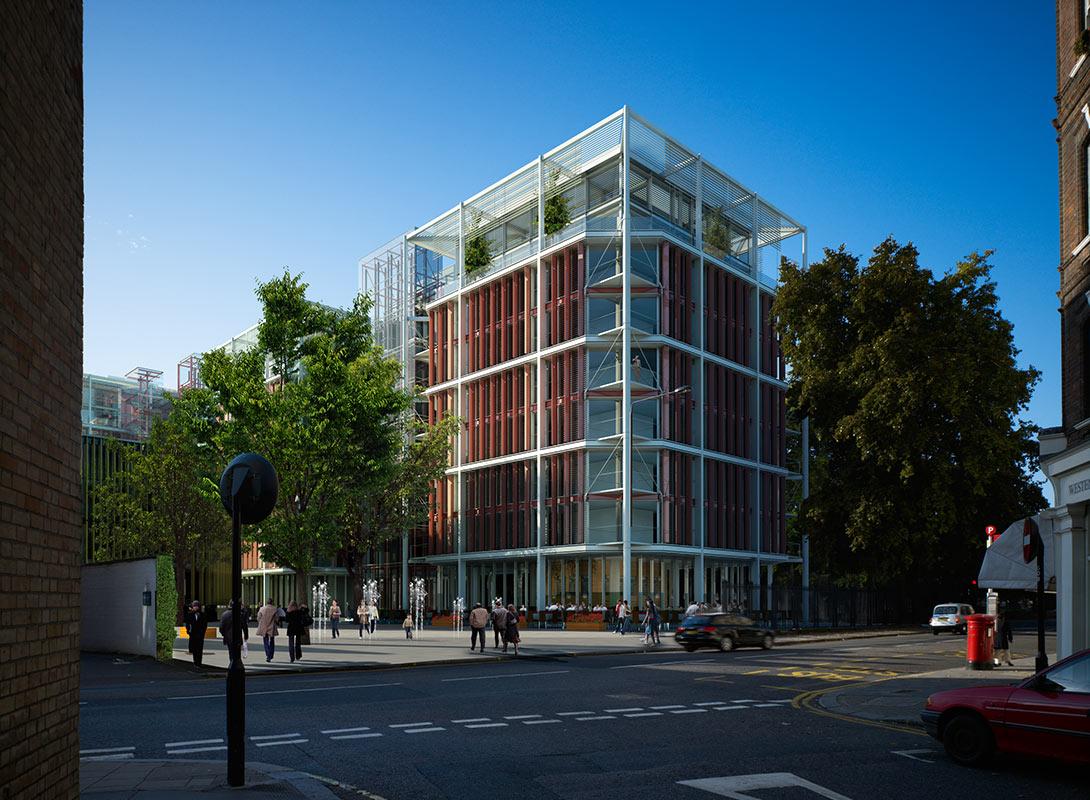
As seen with the case of al Bastakiya, Prince Charles’ ideas on architecture have always reached a zone of influence far beyond the boundaries of the British Isles, not just in geography but monetarily too. The latest row caused by the Prince has been over the Chelsea Barracks redevelopment in Westminster. When British newspapers reported in 2009, that the Prince had written to the Qatari Diar to pull back its support from Rogers’ scheme; the whole episode let to a lawsuit for damages of up to £81 million to property developers[vii].
OmerImage_1
Renderings from the Richard Rogers’ proposed. Withdrawn after a special request by Prince Charles to the Qatari Diar.
Credit: 
Chelsea Barracks, Rogers Stirk Harbour + Partners

OmerImage_2
Squire & Partners’ approved scheme, on the way to realization.
Credit:
 http://www.primeresi.com

However, despite the Chelsea Barracks fiasco, it is surprising to see just how much of London’s architectural portfolio is affected by Gulf investment. The Shard, the tallest building in the European Union is the jewel in the crown of a wide London real-estate portfolio enjoyed by the same Qatari Diar, which includes, among others, the town’s infamous shopping center, some of its most expensive residential units, a portion of its stock exchange, the American Embassy, and a major investment, the East Village, around the site of the London 2012 Olympics[viii]. Funnily enough, the Shard was one particular architectural centerpiece for which the then Deputy Prime Minister issued a planning consent despite heavy opposition from heritage bodies.
Qatar’s neighbors just across the bay, too, have aggressively been investing to get valuable pieces of the city, and although they have recently failed to buy the signature financial district of Canary Wharf in London[ix], the Mayor of London goes to work every day on land developed by financial resources from Kuwait. In 2012, Saudi Arabia invested £60 billion into the UK, while Abu Dhabi’s royal family have become the largest landowners in Mayfair (after the Duke of Westminster) following their own continuous investments since 2006 now valued at of £5 billion[x],[xi]. Some of these projects are naturally faced with much inspection for example, a deal struck with the Bahraini Government in 2013 to help build a new community on a 500-hectare land in the south of the country received much scrutiny from the British public with respect to the latter’s way of dealing with democracy protests during the “Arab Spring”[xii].
Gulf countries are, of course, not alone in investing in one of the most liquid real-estate markets, as their share of investments is on par with those from the Chinese, and also the Norwegians through their government-backed pension fund, one of the world’s largest sovereign wealth funds [xiii]. Owing partly to the less hospitable atmosphere in the United States following the 9/11 attacks, as well as the deep-rooted ties between the Gulf and the UK, the latter has found a source of bullion. It is with relish that the Mayor of London accentuates the city’s status as the unchallenged holder of the “unofficial title as the ‘eighth emirate’”[xiv].
Propelled by this resurgence in its upmarket real-estate, this “eighth emirate” has been forced to make a decision on what type of preservation it should turn its back on: the much-loved landscape or the early-20th century planning ideal that has come to protect much of what still makes Great Britain a mixed land of post-industry and greenery. “Growing up” or “growing out” have been the two alternatives, and the former has been the favored option with demand for high-rises increasing on an annual bases[xv].
Known largely for investing in the trendier areas of Mayfair where Gulf buyers are estimated to be making 10 per cent of all purchases, money has started to pour across the city with an eye to reap the highest benefits from its recovering housing market[xvi]. However, not all of this skywards growth is associated with creation of new human environments. The increasing number of “ghost blocks” has been an outspoken phenomenon[xvii] and with acute housing crisis becoming one of the key talking points for the upcoming general elections in May, there emerges a discrepancy between these new towers of steel and glass and the land upon which they sit.
While this special relationship between London and the Gulf continues to receive a helping hand from the Mayor with his occasional trips to the latter region, there seems to be very limited space left for the Prince who would much rather these skylines be built elsewhere: “It would be a tragedy if the character and skyline of our capital city were to be further ruined and St Paul’s dwarfed by yet another giant glass stump, better suited to downtown Chicago than the City of London”[xviii].
London’s newly found excitement[xix] in ushering foreign investment is counterweighed against its attempts of creating “new old neighborhoods” as part of a legacy plan that sits within a much larger framework of its urban desires[xx]. This sentiment repeats itself in the Gulf, which also grapples with contemporary and contrasting views on urbanism. As new developments in the Gulf continue to mimic Los Angeles or Las Vegas[xxi] more than the Londinium of the Romans, it is difficult to fully explain the rich legacy from which one should expect to draw a different diagram of what “Middle Eastern / Arab / Islamic urbanism” may be. If Richard Rogers is one of today’s most established architects in the UK, Sir Norman Foster’s name will be even more familiar to those in Kuwait and the United Arab Emirates; his firm’s work includes the National Bank and the International Airport in the former and the Index Building in the latter. An ideologue by his own definitions, his vision for the future may have been a motivation for his selection by the people behind the Masdar City development in Abu Dhabi.
Masdar City, to which the Prince of Wales was once made a patron, is principled on the buzzword of current urban times: “sustainability”. It would be a major mistake to single out Masdar as an outlier in the long Middle Eastern tradition of sustainable architecture and urbanism. The project’s ambitions to create a zero-carbon city with its reduced need for energy and water borrows from a long tradition of effective architectural principles developed around these geographies. The city’s tight and dense grid is a direct response to the Islamic urban principle of narrow streets allowing penetration of light and circulation of air, many examples of which can be found not only in the winding streets of Andalucia in southern Spain but in the historic neighborhoods such as al Bastakiya in Dubai[xxii] — whose famous wind towers motivated the Prince’s calls for preservation, have been interpreted with a modern twist at one of the few buildings, namely the Masdar Institute of Science and Technology, that have been realized in what otherwise has been an ill-fated project due to the 2008 financial squeeze[xxiii].
The question regarding the quality of the urban environments in which we live has, intrinsically, as much to do with the aesthetic principles with which they are built, as it has with what sort of human environments they create and who calls the shots (and how) on who will be experiencing these environments, if anyone at all. Just as the Harris master-plan provided a backbone to what was to follow, the opposite forces now leave significant marks on the capital of the once-protectorate. It may help to let go of foregone titles, in favor of a more consistent dialogue, both within and with one another.


[i] Sultan Sooud Al-Qassemi, “Breathing Life into Bastakiya and the History of Dubai,” The World Post, Huffington Post, August 5, 2010. http://www.huffingtonpost.com/sultan-sooud-alqassemi/breathing-life-into-basta_b_488900.html (last accessed March 30, 2015).
[ii] “Lest We Forget: Structures of Memory in the UAE,” National Pavilion UAE, Venice Architecture Biennale. http://nationalpavilionuae.org/architecture/2014-2/ (last accessed March 30, 2015).
[iii] Stephen J. Ramos, “The Blueprint: A History of Dubai’s Spatial Development Through Oil Discovery,” Belfer Center for Science and International Affairs, June 2009.http://belfercenter.ksg.harvard.edu/files/Ramos_-_Working_Paper_-_FINAL.pdf (last accessed March 30, 2015).
[iv] Now renamed Al Fahidi Historic District.
[v] “A speech by HRH The Prince of Wales at the 150th anniversary of the Royal Institute of British Architects (RIBA), Royal Gala Evening at Hampton Court Palace,” May 30, 1984.http://www.princeofwales.gov.uk/media/speeches/speech-hrh-the-prince-of-wales-the-150th-anniversary-of-the-royal-institute-of (last accessed March 30, 2015).
[vi] Robert Booth, “Richard Rogers: ‘Prince Charles wrecked my Chelsea project’,” June 16, 2009.http://www.theguardian.com/uk/2009/jun/16/richard-rogers-prince-charles-architecture (last accessed March 30, 2015).
[vii] Sarah Bell, “Prince Charles’s role in battle of Chelsea Barracks,” June 26, 2010.http://www.bbc.co.uk/news/10282415 (last accessed March 30, 2015).
[viii] Jon Henley, “How much of London is owned by Qatar’s royal family?” December 9, 2014.http://www.theguardian.com/world/shortcuts/2014/dec/09/london-qatar-royal-family-regents-park-200m-palace-harrods (last accessed March 30, 2015).
[ix] Kate Allen, “Songbird board rejects Canary Wharf bid,” January 12, 2015.http://www.ft.com/cms/s/0/ab9521b4-9a6d-11e4-9602-00144feabdc0.html (last accessed March 30, 2015).
[x] Taher Al-Sharif, “Two-Way Traffic”. July 24, 2013.http://www.majalla.com/eng/2013/07/article55243729 (last accessed March 30, 2015).
[xi] Sam Webb, “How wealthy Gulf Arabs are buying up huge swathes of the capital – and now make up a tenth of all buyers in exclusive Mayfair” August 17, 2014. http://www.dailymail.co.uk/news/article-2727212/How-wealthy-Gulf-Arabs-buying-huge-swathes-capital-including-150m-Mayfair-property-year-alone.html (last accessed January 7, 2015).
[xii] Cahal Milmo and James Cusick, “First Poundbury, now Bahrain: Should Prince Charles really be selling town planning to despots?” May 14, 2013. http://www.independent.co.uk/news/uk/home-news/first-poundbury-now-bahrain-should-prince-charles-really-be-selling-town-planning-to-despots-8616371.html (last accessed January 20, 2015).
[xiii] Ivana Kottasova, “China and Qatar buying London properties,” November 11, 2014. money.cnn.com/2014/11/11/real_estate/london-real-estate-property/ (last accessed March 30, 2015).
[xiv] Ben Flanagan, “London mayor expects ‘spacecraft full of bullion’ from Arabian Gulf to land in his city,” February 26, 2015. http://www.thenational.ae/business/economy/london-mayor-expects-spacecraft-full-of-bullion-from-arabian-gulf-to-land-in-his-city (last accessed March 30, 2015).
[xv] Kate Allen, “Forest of luxury flats rises on London’s skyline,” March 15, 2015.http://www.ft.com/cms/s/0/a4df73e0-c96d-11e4-b2ef-00144feab7de.html#axzz3UZj1Plbj (last accessed March 30, 2015).
[xvi] Lucy Barnard, “London counts on safe-haven appeal for Middle East real estate investors,” August 20, 2014. http://www.thenational.ae/business/property/london-counts-on-safe-haven-appeal-for-middle-east-real-estate-investors
[xvii] Nicholas Shaxson, “A Tale of Two Londons,” April 2013.http://www.vanityfair.com/style/society/2013/04/mysterious-residents-one-hyde-park-london (last accessed March 30, 2015).
[xviii] “A speech by HRH The Prince of Wales…’’ Ibid. (last accessed March 30, 2015).
[xix] Rowan Moore, “How a high-rise craze is ruining London’s skyline,” December 2, 2012.http://www.theguardian.com/artanddesign/2012/dec/02/london-high-rise-craze-ruins-skyline
[xx] Ricky Burdett, “The London Olympics – making a ‘piece of city’,” August 1, 2012.http://blogs.lse.ac.uk/politicsandpolicy/london-olympics-making-piece-of-city-burdett/ (last accessed March 30, 2015).
[xxi] Murray Fraser, and Nasser Golzari (eds.). Architecture and Globalisation in the Persian Gulf Region, 2013, p. 21.
[xxii] John Lockerbie, “An approach to understanding Islamic urban design,”http://catnaps.org/islamic/islaurb1.html (last accessed March 30, 2015).
[xxiii] Nicolai Ouroussoff, “In Arabian Desert, a Sustainable City Rises,” September 25, 2010.http://www.nytimes.com/2010/09/26/arts/design/26masdar.html?_r=0 (last accessed March 30, 2015).

Sunday, February 08, 2015

But Capitalism is Realism

I got to learn to love Rothko. I was taught to appreciate Beuys, Baselitz, Balthus. I am not sure if the letter B was a coincidence but it wasn't difficult to fall in love with Bauhaus anyway. I always had a thing for orderly shaped structures. In my first ever visit to Berlin in a cold August day in 2005, the Bauhaus Archiv was amongst my first stops, along with Neuenationalgallerie. The efficient linear geometry must have appealed to what my friends regard as my highly analytical mindset. In Turkish, there are a few sayings on people with perfectly "cornered" (or rather right-angled) attitude/mindset/life view -- they are a bit "thick". And so was I, perhaps. That is why Kandinsky came along rather easy, and so did Malevich (and I am sure this is blasphemous).

In any case, this is not about throwing in some major 20th century modernist artists names out there to prove a point. It is about the feelings and thoughts that crossed my way today when I went to see the Sigmar Polke exhibition at Tate Modern, on its penultimate day. It wasn't a perfectly planned day and in fact I had no intention to see the exhibition. A former opportunity I had with Z. was quickly replaced by heavy indulgence in cheese and wine at Gordon's Wine Bar. The exhibition's posters had not appealed to us (and in fact, I now think they are poor representations of the contents of the exhibition) and I for one, had almost no information on Polke and his work. Maybe I'd heard his name in passing in one of those Uni. courses where I was taught to appreciate everything Beuys had to offer to the world -- Beuys, whose disciples (and amongst his fierce critics) included Polke himself, of course.

Today's programme came out of the blue, as well -- or rather out of my wardrobe necessities. If the Argos branch in the Cannon Street Underground Station (yes, there is an Argos on the Underground/Rail Station, which I believe is a good way of utilising some spare storage space) wasn't the only Argos in the vicinity to keep some much-needed wooden hangers in stock, I would have never gotten to write any of this. When my flatmate O. said he'd go see the Polke show and enjoy some fish & chips near Waterloo, I could not think of a better scenario in which I could burn some much needed post-battered cod calories one a journey on the bicycle back via Cannon St. where I could also pick my hangers up... Little did I know, I'd end up indulging myself in deconstructing my own myths on the superiority of the post-war artistic movements, including American take on abstract expressionism, which of course followed from my deepest appreciation of the modernist arts and design movements, at the core of which sat the inter-war period preceding, but not necessarily rendered irrelevant for Polke's references. Wasn't it at Tate Modern, some years ago, I saw works of Otto Dix and others and re-established for the xth time that times of hardships bring about some of the most sincere and sensical pieces of art --- well, all generalisations aside, Polke's 1960s welfare, baby-boomer, West German fuelled art came as a slight refreshment and a cure to a stomach consumed by deep-fried crisp.


There are a few benefits to studying history and sociology for four years: you know (to some extent) what happened at certain periods of time in certain parts of the world and you can most often find discourses, trends, contexts to link things with one another -- especially if you are a bit "thick" like I am. So, it is of little wonder that I usually enjoy the contextual framework of major art exhibitions the most, and there is as much context as there is history. With some decent descriptive guidance, it is very easy to appease me with any exhibition Tate Modern would put together. 

After that due introduction, I should strive to explain why what I got out of Polke's work was still so significant in its own right: First of all, what I learn from Tate Modern's description of Polke's work and its carefully curated sections that include one on "Modern Art" where he criticises the works of Malevich, Pollock, and the American Pop Art, yet by utilising some of their distinctive forms (and at this point, I have no other guidance into Polke's thinking than what I am reading on the descriptions at the exhibition and what I am seeing), is at least a challenge to some of the artistic values I have been taught to appreciate. Moreover, perhaps, it is one of those great intra-art-scene playfulness that these "great artists" played amongst themselves. Polke, to being with, is hardly outside the establishment, something neither he nor the exhibition has any attempt to disguise. It is his critical approach to what he is dispensed at Kunstakademie Düsseldorf that creates the much celebrated artistic figure by the end of the 1960s. And it is this celebration, amongst what the dawning of the post-war West German society brings to convenience his later departures from the urban, from the mundane, and towards the spiritual (by way of experimentation of drugs, of course).

Polke's subtle but unsettling relationship with his predecessors and contemporaries and some of my "artistic heroes" is at first satirical. Ridiculing the African interest in early modernist painting, undermining the t-square is all entertaining and provocative but, as can be expected, Polke is very much moved by the very tools of the great works and he is no short of implementing similar methodologies both during his earlier and later years. What is most impressive is his experimentation with new methods -- whether that be unique materials deployed on his canvases, or the break away from the standard canvas as we know it -- yet Polke's outputs, as compared to his contemporaries has but got the thinnest boundaries to tell them apart.


The crux of my unexpected date with Polke is how I seemed to find myself appreciate the methodologically subtle but visually strong response Polke had to his contemporaries, which, in turn becomes his own undoing. Polke, in my opinion, is another one of those great post-modern artists before the dawn of post-modernity and is a great modernist long after modern movements (as we know them, in this geography) have been abandoned. Not that Polke has any claim to any of these entitlements anyway (my information is solely based on information boards and the curation with which I am made to appreciate his work) -- the artist seems to have successfully avoided unnecessary publicity.

What is left, then, is all the emotions one goes through when you see the progression from his small-scale drawings and sketches of the early 1960s, to reach levels of certain transcendence in 1970s and depiction of paths beaten to Afghanistan and Pakistan and engagements with peoples and produce of a new geography and semi-experimental videos to gigantic canvases spanning East-West German borders to Papua New Guinea. And as personal as they are, how I took in all of that is much harder to describe and share --- for all I know, the more accommodating I become in my own fallacies, the wider the spectrum becomes. Polke certainly gave me a good nudge with that.