Wednesday, November 15, 2017

clumsy

I was just going through and clearing my emails in my Admin / IT sub-folder and just came across this... and remembered the chilly and chilled Toronto evening when we shared a plate each of tuna, chicken and aubergine (sorry, eggplant) and sipped on Filipino hot toddies. 

On a day when days have somehow lost their sense and sequence; my mental calendar would tell me that was only 10 days, and about 30C degrees and a 8-hour time difference ago. Where the landscape is awash with sandy yellow submerging with clumsily and hastily made steel and glass of Kuwaiti skyscrapers whereas they would have been much better off keeping to their local tradition and scale, at which they are very good at, I'm reminded of a suburban landscape, colours of which neutralised by the cold, dry air. Only 48 hours after flirting with the feeling with I could just live there with a few very dear people to me (no matter how much and how far back I've known them), would I arrive in New York -- no longer than 48 hours in that magestic city, and it would immediately feel my natural home. And then Kuwait, the Middle East, the sand, the inefficiency, lack of transparency, covered all over in white and oil-dripped sand; another home of the sorts...?

And then I go back to this email... and I miss Toronto, and the dinner, and the walk... not so much the sore throat but the sweet goodbye.

Wednesday, November 08, 2017

falls for the falls in fall

A non-descript diner on the corner of a three way junction in a US border town. It’s 11:56 AM, it’s Wednesday.

I grew up hearing about Niagara Falls; it’s one of those places that kept popping up on travel ads or TV shows in the 80s and 90s, and couldn’t escape the attention of those culturally Americani(z)ed.

The friendly conductor of the train walks into our ‘business class’ carriage and announces that we will soon be crossing over to the US side of Niagara River. “On the left hand side will be the best view you’ll get all day today”, warns he. “Oh, look, he’s getting a real good picture of that” exclaims the old lady to her husband, who are sat across the aisle from me.

They’re from Kansas City I learn, about 10 minutes later. She’s got long, grey hair, a very pale lady with ice blue, smiling eyes. Her man is carrying a cherry red stick, he gazes at me underneath his cap, his posture slightly scanted due to his hunched back. They set off from Kansas City to Los Angeles, up the West Coast to Vancouver, then across the maple leafed country to Toronto.

- Via Rail runs on CN tracks; we yielded 25-50 times and got delayed for 10 hours.
- You must be exhausted. Did it affect your connecting journey?
- No, we’re just tired. It’s just that, we never thought we’d stay in a hostel aged over 80. But, it was good.

They’ll get to Chicago before returning to Kansas City, to go back to their two dogs. “It’s easier looking after dogs than children at this age” claims the uncie. Aunties asks how many children I have: “no children, nor dogs” say I.

Border crossings have often been eventful for me. In fact, we were exchanging such stories over the weekend with E., N., Y. and C. on Sunday at Toronto’s Kensington Market.

I get way more questions asked at this rail crossing than I had at Logan Airport in Boston, last week. Train crossings are always curious things. Especially in this part of the world where they’re rarer, they’re almost archaic and have a vintage quality to them. Suspicions inversely correlate with diversity of nationalities that traverse them. It didn’t help that the border officer back in Boston forgot to stamp my passport. Officials had to go through security database to verify my first entry to the US before I hopped over to Canada. I had to pronounce “architecture” three times to the officers when asked where I worked and reveal I didn’t go to any architecture school — a phrase I had to keep repeating, back in Boston last week.

It meant I was left behind by the others and running out of time to leave the station for a quick meal but the conductor nevertheless waited for me at the ticket booth. He knew I wanted to ask if I could get a business seat for the remainder of the journey on the US side — a long, 9.5-hours ride, worth the meagre $33 difference. He thought otherwise: “I wouldn’t, if I were you — seats on the coach class are even wider, and all you get is extra water or juice in business”. I felt slight trepidation as the ticket cashier waited for my decision; I didn’t want to hurt their business upon the conductor’s advice... but little did the green-eyed, ruffled bearded , tall man care. “Let me know if you change your mind”.

I was joined by the blonde, young, on-call assistant conductor walking up the city’s high street to the diner the conductor sent us to, to get a $3 breakfast. She could be a character right out of Fargo. It’s her neat conductor’s suit, Midwest accent, and pale blue eyes against the backdrop of a small, suburban US border town with narrow roads and hanging traffic lights, all catering to my prejudice.

The diner is shut; I find another one up the road; she says she needs to get back so I foot it rapidly. It sits in the corner of a three-way junction. It’s called “The Why”. That must be the US equivalent of “Neden Urfa” that keeps bemusing us Turkish speakers wherever that restaurant name pops up.

Two thin, black ladies with braids wait at the door for a table and just before suggesting I claim an vacant bar seat, their three friends walk in. It’s the black kid’s birthday and they hug each other warmly; he’s a little embarassed while his two white friends behind him smile. “Didn’t you get my text? It says ‘sent’ here”. He scratches his right ear and the golden ear ring with a baffled, amused and happy look on his face.

The kind lady at the bar suggests I can get #2 breakfast and coffee with the only 4 US$ I have in my pocket. They don’t take card, nor will they accept my remaining 2 CAD$.

- The nearest ATM is by Pops, just up the road. Do you want to order after you get back?
- I’ve got a train to catch. Can I order #3 instead? I’ll leave my jacket, run there and back real quick.

And off to the races, I go. When the sun’s out, it’s that beatiful, clear, crisp, coldish winter weather out there. I get to the mall, get cash and even a bottle of maple syrup promised to A., my host in New York. When back, I find my breakfast covered over with an additional plate to keep it warm.

At the end of the bar table is the owner of the dig, wearing a cross over his neck, curiously observing my movements. Including the bacon in the mix might have been my saviour. As I turn further around, I catch the beautiful smile in that black young lady’s face I had seen at the door. They’re now joined by a party of 3 more people. I figure this was a suprise lunch for the birthday boy. Her smile makes me think of B. from high school. I haven’t seen her or spoken to her for 3 or 4 years.

I leave the nondescript diner on the corner of a three-way junction in a non-descript US border town. Back at the train platform, the conductor, the assistant conductor, an engineer and another man are chatting.

- Sorry that the diner was closed!
- No problem. I went further up the road to another one. It was pretty good.
- Oh. “The Why?” I was always wondering. How much did you pay?
- They have eggs, toast and bacon for $3.20 and coffee is 95 cents.
- See, that’s great. One time, I took the wife to NY; we stayed right by the Times Sq. Went to that famous diner where they shot Seinfeld episodes. They charge $18.99 for two toasts and coffee!!! And $3 for coffee refill.
- You should have walked away with the mug!
- We didn’t stay long.

Shortly after that, we left the station. We will be crossing New York State over the next 9 hours, rolling down Hudson and Harlem Rivers into Penn Station. I’ll be doing a lot of reading, preparing for Kuwait while post-industrial fields, empty mining quarries and leafy suburbs will fill the landscape.
When the Maple Leaf service arrives at its destination, I will emerge on to the streets of one of world’s densest cities.
The kids will be celebrating their friend’s birthday.
Readers will be leaving the town’s beautiful, brutalist library.
Diners will be sipping their milkshakes or coffees on a cold, crisp, early winter’s night.

8 November 2017, Wednesday
Niagara Falls, NY

Thursday, October 26, 2017

dundee arms, formerly aka foo fighters arms, formerly aka dundee arms

22 Sept. 2017

Dundee Arms. Thursday night, 11PM. A pub stood here for as long as anyone can remember. Over the past week, Foo Fighters (yes, the band) took over the pub and made it Foo Fighters Arms, a pop-up band pub. The band didn’t turn up but thousands of fans did, every single hour of every day of the week.

About a few hours ago, all the shenanigans have ended. I’m sat inside, hearing Ritchie Blackmore rip his riffs. A young couple asks for pints of Session IPA — pointing at the blue cans in the fridge behind the bar, she claims her stepfather loved that particular brand of beer. The bartender advises they go to the nearest off-license to buy some. She repeats directions given to her, an American pronunciation of “Bethnal Green Tube stop” sounds friendly out of place.

A group of long, curly, blonde haired dudes walk in. They’re not Deep Purple (who’re not blonde) and they’re asking for a club nearby. Strangely out of the era their looks represent.

A shy boy walks up to the bar and asks for a pint of “the Roadie”; my choice of IPA. I’ve always gone for roadies.

A man walks up and asks whether I’m writing a book. I tell him I’m writing semi-fictitious stuff. That I’m making up some of the stuff that I have or have not seen — as I’m typing it.

I gave the last new, Jane Austen £10 note I had in my wallet to the bartender. Why Foo Fighters didn’t turn up for their pop-up bar is because there’s no back door entry to the pub. Crowd mitigation out of order. It would be appropriate if the music mixer behind a bricked cubicle (with a massive TV overhead, probably showing rugby games on the weekends) queued up The Doors’ Back Door Man.

A man walks up to the bar with a bunch of brochures in his hands. He’s told Foo Fighters Arms is over. It sounds like a whole musical genre has been proclaimed over in a 90’s rock’n’roll roadie movie. I take the final sip of from my pint of The Roadie.

An Irish sounding girl walks up to the bar — she’s recently moved to London. A Celtic sounding folk tune is heard over on the stereo. My flatmate texts he can’t make it as he’s too tired while I get my 2nd pint served. Since each sip continues to taste like I’m chewing on a small branch of weed must mean it’s not the glass, it’s the actual drink.

Of the three blondes who’ve just walked in, one asked for red wine, another for a Corona (keeps the slice of lime intact) and the final one a prosecco. That’s what I call diversity; bar the equally standardised hair dying operation in place.

The very important information that they’ll close at 12:45AM relayed to me may be a curse or a blessing in disguise. I need to leave home at around 03:30 for my flight to Denmark.

The journey to the bathroom is a peculiar one: as I walk away from the dimmed Art Deco lighting up the Victorian stairs into an empty hall, the last thing that would cross my mind is to run into a group of Icelandic and British birthday crowd who took over my stool. Only one of the three Icanders isn’t shaven headed but they all smell of lavender amd sweat.

A dude was complaining in the toilets that someone walked out having not washed his hands. He claimed his OCD got the better of him. He proclaimed: “why not wash your hands? It’s free!”

The Icelandic crew are slightly disappointed no pastice is served. The sambuca alternative does not cut it.

The long anticipated Old Fashioned is ready. The dude who’s kindly asked for permission to ‘borrow my stool’ had long gone and once the Icelanders have left, I’m back on my stool. The noise level has gone up by a few notches and Nirvana is on stereo.

The more I write and observe, the more I get counter-observed. Is it the recently acquired self-proclaimed author’s gaze I’m receiving reactions to or is it just it’s getting very crowded?

I get wrongly served a pint of soda after I’d gotten served a G&T, by the same man. First single malt request comes in just as a super-oriental Rock The Casbah cover kicks into the stereos as the Black Rebel Motorcycle Club crew (had appeared while I was in the loo) go mad.

A super drunk local dude asks me about lagers.

Half an hour later.. suspecting his accent and acquainting all the while, he turns out a Mancunian. Construction, Principal Tower, the Queen, pension age, Spain, Montenegro, his daughters and family, 3AM shifts, are amongst 100s of stuff we talk about.

He’s missing few teeth. He rolls his o’s to u’s as a proper Northerner. He’s baffled to hear I’m Turkish. He’s obsessed with Spain. He only took a week off in the past 3 years. He doesn’t like the fancy lager offered on tap.

He hits up on one of the 3 Corona, Prosecco, Wine blondes and I’m relieved. I’m relieved I can write again. I’m relieved he subscribes to the standard — so, my prejudiced observsation stacks up. Shame on me. Shame on whom? They’re almost kissing and I couldn’t care a tiny less. But he’s cool. He’s a Danny Boyle character that didn’t make the silver screen.

He is hating his Camden Hells. He was here all along for Amstel. I’ve got 3 more hours to waste. A direct reverse correlation between alcohol level and striving to keep awake will play against me. Where do I cut it?

The blonde approached by my Mancunian takes up on the OCD guy. He runs away. She asks me how to get back to the bar. Her lips might exlpode. An Icelander walks past. I’m worried about my flight. The stomping on the timber stairs is mixed with vanilla. Vanilla came apparently from our Mancunian’s e-cigarette. So much for the pension scheme.

Nirvana’s on again. Smells Like Teen Spirit.
Feels like teen years.
Feels like I’m done.
This is Dundee Arms.
It’s 00:44.
London’s a tough place.
It’s not been easy.
I love London.

Thursday, October 05, 2017

pride in our parks

I received a message on LinkedIn asking me whether I wanted to share a regeneration project I was involved in to be promoted by some online publication. The request didn't appear anything much more than an attempt to aggregate some success stories for a self-proclaimed publisher and their blog/book/magnum opus.

Nonetheless, I tried to come up with something worthy of a mention and moments before I would receive a notification on my Twitter feed of a retweet by RioOnWatch, I reminisced of an emotional moment just about 4 years ago these days from Rio de Janeiro.

At the time, I was in charge of coordinating and running the floor for the Urban Age 2013 Conference -- as Rio was gearing up for the 2014 World Cup and the 2016 Olympics, we were investigating major investments (mainly in transport and regeneration) and whether they related to / tried to alleviate some of the chronic problems facing the city. We wanted to highlight Parque Madureira as one that gifted the city with a public asset in a once redundant / obsolete part of the city.

The architects in charge of the project presented the project at the conference. While prepping for the actual conference, testing A/V and lighting, we've run each presentation to the desired setup and presentation sequence. One of the technicians in charge for the technical desk first erupted to shouts, laughters and excitement which were then slowly left to a mix of emotions and tears. He later told me he grew up in the area of regeneration, and was now using the park and very proud of it being showcased as a prime example of regeneration at the Conference.

This, for us, was a testimony of a story of success and one that probably merits a narrative and a reminder at times when there's little appetite or faith left in mass regeneration. At a time when I've been desperately searching for some inspiration, how I recall the joy and pride in that man's eyes...


Monday, February 20, 2017

as the desert runs into the sea

When you’re left dehydrated for four days in a desert, you begin to lose sense of direction, walk in circles and eventually starve yourself to your inevitable end. US border officials know this too well and are often left collecting corpses beyond recognition of those who desperately try to make it across the ruthless Sonoran Desert. That, or they encounter them during their journeys and take them away, but not all those journey-makers prefer this latter outcome. Exploited by traffickers on the Mexican side of the border, if they can manage to complete their perilous walks, they hope to find a safe haven, and sometimes find themselves knocking on strangers’ doors, only to hope that they’d extend a helping hand rather than turning them to the authorities.

As fatal as they are, deserts can be incredibly inviting geographies; with no end in sight, an infinite depth of field and an offer of wilderness that us humans have long let go of our lives, which immediately draws one’s gaze. Borders on the other hand, especially those with walls, fences or any other invisible apparatus of control are usually repulsive. In the case of Joshua Bonnetta and J.P. Sniadecki’s “El Mar La Mar”, these attributes are reversed; or rather merged: the Mexican-US border at once draws the pair in to tread a careful and sensitive excursion around it. They were taken by both the landscape and the hard border on a trip from New Orleans to San Francisco and started to storyline what is truly an intense documentary of survival and expulsion.

Shot on a Super 16, the film is a visual feast of landscape imagery, combined with some incredible and innovative sound design. As the southern Arizonian images of nature, wildlife and cowboys blend into whitened- and blackened-out images, uninterrupted testimonial interviews with border officials and journey-makers alike are mixed with field recordings, sometimes in their raw format but most times manipulated with additions of reverb or stretching out of frequencies. Hardly any of this comes as misplaced as they create an environment that is both very impressionistic but also abstracted to such extent that Mexicans' heart-wrenching stories create the incredible tension that the film rests on.

The film is split into three sections titled: “Rio”, “Costas” and “Tormenta”. I had my own interpretations but also went to ask the directors why they did not translate those titles, to which they replied they wanted the audience to keep engaging with the film by researching them if necessary and that they had only finished editing 5 days prior to the screening! But as a contextual point, the film's opening title "Rio" begins with a flickery image recorded from a moving vehicle, which, as the camera zooms out, slowly morphs into a recognisable image of a metal fence. It is one of the most dynamic scenes of the entire film, as the rest is very much made of a static (and stunning) visual language. But, despite that slow pace, the film is anything but stasis. The directors did an incredible job of marrying their audio-visual interpretations with people's testimonials and allowed for these to speak for themselves, and safely stayed away from taking a stance.

The shortest description I could make for the film would be “excruciatingly beautiful”. As I arrived in Berlin on Sunday late afternoon, I was still filled with certain inspirations I had acquired over the weekend. Ending up at strangers’ house late on Friday night, finding myself playing percussion in an impromptu house jam session, and meeting the same incredible people who had put out an exhibition at St Pancras Parish Church’s Crypt Gallery the next evening had already filled me with much anticipation, as if the prospects of going to Berlin, one of the most special places in my life, was not enough.

Titled “CAPUT”, that exhibition that displayed works from artists from France, Greece, Italy, Senegal, Turkey, the UK and the US not only responded to its own setting so intelligently, but also portrayed the interplay between life and death, the dynamic and the static. Everything I saw at El Mar La Mar seemed to have this incredible point of reference to works I saw and experienced at the exhibition. Can’s video installation complimented by sound recordings from the materials he used was as genuine as Bonnetta and Sniadecki’s mix of the harsh audio-landscapes, metallic surfaces and the soft human touch of border-gazers. Beyza’s poetry and grainy video footage were almost a response to the filmmakers’ own use of artistic language, through blur and abstraction. Having experienced a monochromatic part of her video, I could not help myself but remember how El Mar La Mar’s brutal black or white backdropped scenes of testimonials merged into the landscape photography. And Merve’s three paintings, with a varying tones of red, green and beige from vivid to pastel had defined my interpretation of the exhibition: although she refers to themes of harvest and blossom, their spatial features and subtle lines gave me an immediate feeling of rugged but tested landscapes and borders. Her painterly abstraction did not give me a feeling of exclusion; on the contrary a sense of invitation and intrigue.

So, it was almost hardly a coincidence when the Berlinale presenter on stage addressed her first question to the filmmakers about the painful beauty of the film and how its poetry-like structure almost made Sonoran Desert an appealing place. My second question was about the two men who walked for 8 days and ended up at knocking at the ranch the filmmakers were staying at. They connected them with humanitarian focussed organisations, while receiving their testimony of the journey. The men were very tired, sleep and water deprived over the final few days of their walk and had almost acquired a totally indifferent feeling to the emotions they were suffering from, except, when they talked about a fellow female traveler who died as they had to leave her behind, one of them started sobbing. I wanted to know how the directors approached these men about a story so traumatic and had just taken place: apparently, the men wanted to put their story out and the filmmakers were, by this point, experienced enough to create the optimal distance that allowed them to investigate deeply with true interest but remain emotionally stable as not to take a subjective stance. That's why this film was so powerful. So human, despite very few humans seen in footage.

Writing this text took me longer than I anticipated. In between the 11 films I saw, friends I met, very different environments I have been in (both physically and spiritually), my initial feelings towards El Mar La Mar stayed the same. If anything, they have been supplemented by various inspirations through the week, culminating with an unexpected approach on the dancefloor at the end of a long clubbing night (and morning) with the statement “can I dance next to you; you look so happy and make others happy” — something you don’t expect to hear much in Berlin, the ultimate individualist capital of hedonism.

But, that was also reminder of how much we seem to strive for these interactions and the need to really understand and communicate what we individually and collectively go through, whether this be with complete strangers or our neighbours. In fact, often is the case that the more we connect, the less rigid those definitional boundaries become. Like the first scene in El Mar La Mar where the fluid image turns into a hard fence, or the weekend in London that prepared me for my journey to Berlin… with gratitude to everyone who keeps inspiring, old and new alike.

Monday, February 06, 2017

cruel sun on a fake spring's day

the sun came out today. when i was least expecting it. and when i was certainly not ready for it. when it came out briefly on saturday, i was again neither expecting or prepared for it. but, it came with warmth, with a hint of smells of flowers, with long walks, hat shops and unexpected pub stops. it came in the form of pale ale and sushi. and when it left, i could do without it for a while. now that it's back, i don't know what do with it.

...because it wasn't real spring, and it turned out it wasn't here to stay.

Sunday, January 08, 2017

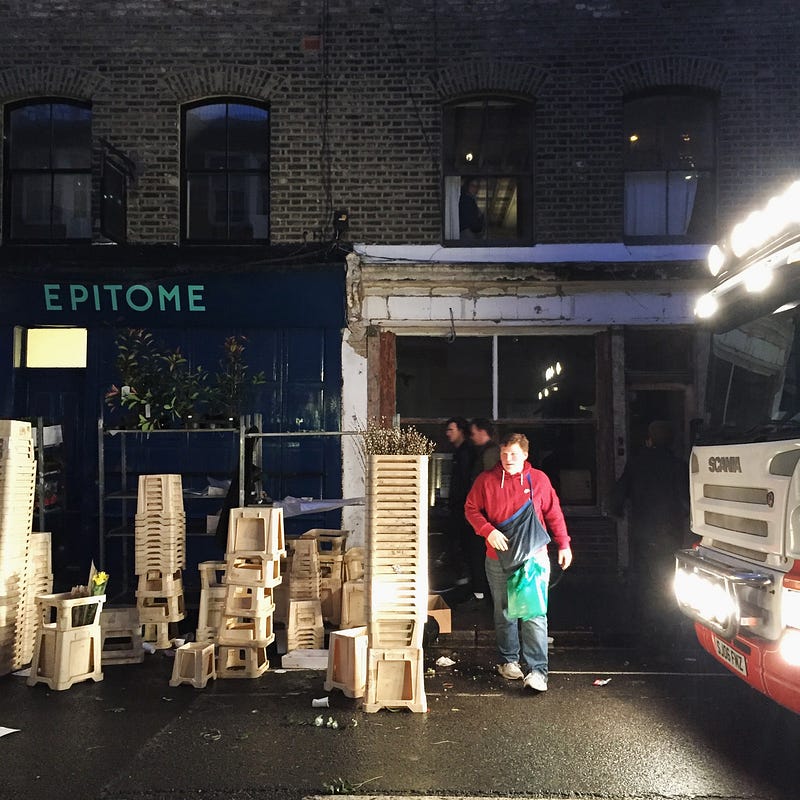
Here comes the piss truck

“Here comes the piss truck” they were yelling and laughing. I don’t know why they call it that, but its arrival felt like a regular proceeding to the end of another working day for the Columbia Road Flower Market. Street markets are strange, in the sense that they have a single day working week; albeit an intense one at that.

Stranger is the three-sided football league we play in. A single, two-hour endeavour, first Sunday of each month. Less stranger is ‘planned engineering works’ that take place across various public transport infrastructure networks of London. Which is why, I had to cycle on a city bike to Tower Bridge, and run to New Cross thereafter, courtesy of my bike’s broken pedal and the festive period that prevented a quick fix.

That stretch of South London on any given Sunday is primarily home to communities of Afro-Caribbean origin who stroll between their homes and those of their relatives and their local centres of religious affairs. Congregations in front of brickwork, concrete or makeshift churches, Victorian, postwar, or semi-urban houses are celebrations of colour and glamour.

Running on a side street somewhere between South Bermondsey and Surrey Quays, I came across a lady, all dressed in white except for her golden necklace and the grey earphone through which she was euphorically talking to a relative. Her posture could not have been any calmer, though. She was taking small and calculated steps and owned the very pavement we shared for those few seconds. She smelled of summer; the streets smelled of River Thames’s low tide. By the time it reaches London, the river picks up some salt and it was this indistinct trace of smell of salt that was helping my head keep clear.

The game went well; we did a good job. It’s now 3 games without a loss; a straight out win, followed by two winning draws. We jumped on the unreliable Overground on the way back, which was now running a more regular service. I took my usual route from the station but instead of cutting directly across to my street, my feet dragged me across Columbia Road (next street up) to see the market day come to its conclusion. Only few more stalls were up, and there has been carnage of flowers; those that did not make the cut and were not walked home by young couples and aspiring flatmates.
A very loud truck started its engine and started rolling up the street. When it finally stopped before the last stall standing with a loud roar, the driver jumped out to the yells and laughs of the traders. They called it the ‘piss truck’. Another week had just ended with little out of the ordinary. The ‘piss truck’ was about to start its duty of sweeping away the end of the week as I hastily, but calmly, took this picture.

Saturday, September 03, 2016

https://www.youtube.com/watch?v=Qj5x6pbJMyU


3 Summers ago, me and my flatmate took a trip down to Congo. We didn't venture out all the way to the actual country; crossing the Thames was good enough. At the Young Vic, we were treated to a 3-hour long drama about the rise and the fall of Patrice Lumumba. At every moment, it felt like, we were in Kinshasa or Kisangani, following the dreams and aspirations of a young and rowdy idealist. Little did we know that the stellar performance was portrayed by none other than Chiwetel Ejiofor, until we saw him on the silver screen a few months later with 12 Years a Slave, earning him a nomination for the Oscars...


If Joe Wright's "A Season in the Congo" at the Old Vic was (goo.gl/9XUWcN) as much an architectural reconstruction of the Congo in the 1950s, Onashile's setup in the tiny Blue Room of the Southbank Centre could not have been any more minimalistic, yet all the same representative of a nondescript, imaginary music club in Glasgow. Yet, the four female actors; Teri Annn Bobb Baxter, Jamie Marie Leary, Diana Yekinni, and chieg among them Sabina Cameron took us back and forth between Scotland and Kalakuta, Lagos. Tolu's dreams were made and quashed between the dance floors of The Shrine and the toilets of a Glasgow club. Running just short of an hour, on a stage of a few square feet and a few props; the play, as part of the Africa Utopia weekend at the Southbank Centre, ironically clashed but also complemented the textile and souvenir stalls upstairs and the food market just outside the building. With the actors' final moment of reckoning against the male gaze, the male oppression and an homage to Fela Kuti and his fight against colonialism and corruption, the stage and the spectators were set ablaze. It's almost as though my current flatmate saw it coming when she told me as I was leaving the flat earlier: "I'm sure you're really going to enjoy the performance!"


]This side of the river is home to so much significance and magnificence in my life. I walked to my bicycle which I had locked to my favourite ever cycle rack in the entire universe (the magical story from March 2016 here: goo.gl/N6mNmo).
As I was cycling home, felling all inspired and still ablaze, I was confronted by the "Great Fire 350", urban, public installation in front of the St. Paul's Cathedral. Only two days ago I had met a friend here and was telling about how the architectural marvel that is St. Paul's is only over 3 centuries old in its current incarnation, owing to the Great Fire of London (1666), which, among many catastrophes, rewarded to London and cemented the influence of great Sir Christopher Wren. Now, here, an event was taking place to "celebrate" the great fire and its (extremely important) place in the history of London. On the grounds, where, few years ago we were hearing Julian Assange shortly before his captivity at the Ecuadorian Embassy, when "Occupy London" began, where, for months in, months out, tourists to London would share the space with dozens of tents. ... And there I was thinking... just a while earlier, what other city in the world could pull off a Colombian weekend and an African weekend and an X, Y, Z weekend one after another in the same, public space. What other city in the world "celebrates", with a degree of humility, and a big dose of resilience, a major catastrophe that brought its capital city to its knees from 350 years ago?
London. Noone can come between us, not even Theresa May!


Friday, July 29, 2016

After a 5-minute deliberation or a 15-minute drivearound, I parked the car on Esplanade by North Derbigny. It looked safe enough to escape a parking ticket, yet shady enough to warrant an overnight break-in. At this point, I rated the former over the latter. I got out of the car and looked around. The driver of the car behind ours was inside and gestured at us. He was about to rest the case on both parking tickets and safety. He was to be the Damiel, watching over Wim Wenders's Berlin. 

He came out of his car and asked for some change. I gave him the four quarters I had in my pocket and turned to him to add: "I only have four quarters in my pocket." 

He replied, with his thick Southern accent: "I need the cash for the tank, man. I need to get to my job." By this point in the trip, I was able to articulate a fair ratio of the Southern accent thrown at me. By this point in life, I was able to articulate largely how genuine such requests were meant. But I only had four quarters in my pocket and I gave him all.

I knew exactly which direction we needed to be headed. I played dumb to waste time, so I could observe the man's next moves. If he were to break into the car and even if that took place hours later, I had a sense I could be able to tell, if I observed long enough.

I turned to Z. and pretended to check our destination on Google Maps. Damiel came forth and asked if we needed help. We didn't need any help. Not from him, nor from Google Maps. I knew exactly where we were going. 

I turned to him and said: "Sure, we are trying to get to 623 Frenchmen." We were following the advice of S. who was going to host us the next evening, whom I had not seen since we finished Uni. The Spotted Cat was one of his favourite in town!

Damiel knew. He lifted his head, quickly turned his slender body on his feet and walked back towards his car, murmuring: "just hold up, I'll walk you there."

"You don't need to bother man, but as you please" was a redundant British politeness. The Creole kindness swiftly ignored it.

We crossed the street and started walking south. By the next block we were already back in French Quarter keeping our direction until Burgundy, one of the few southeasterly crossing diagonal streets into Frenchmen. He exchanged greetings and handshakes with a few people on the Esplanade. I asked him about the devastation caused by Katrina. He told us everywhere around us flooded except for Bourbon Street: "the rich are always protected!"

He wanted to make sure I knew exactly where we turned left and then right again, so I could find our way back easily. But we weren't walking back to the car at the end of the night. We didn't sleep in our car. He did.

Damiel was a 53-year old man who occasionally did labour work. Whenever he could find one. And whenever he could put together enough money to put gas in his tank to drive there and pay the $10 upfront to secure accommodation and shower for the three days he would spend out there. He had three daughters, aged 31, 29 and... before he could tell us the other's age, he got interrupted by a local. They've had a quick chat.

"Aaahhh, you want to know more about Katrina", he said half jokingly when I asked him another question. He hadn't seen his daughters in many years. They lived in Texas with their mother. Did they now also have a stepfather? He was living to see them again, as soon as he could. He lost them, as he lost all else to the storm.

"If I came to your town, I would want locals like you to show me around. That's why I am walking you to your destination" said he, while pointing out at a few restaurants and bars he said we could check out. We knew exactly where we were going. He knew exactly where we were going. He was sharing his life, and his city with us. 

He didn't mix Turkey with Kentucky when I told him where we were from, unlike that young police officer on the highways of Mississippi who stopped me the day before. That officer had advised me "to watch yourself in New Orleans; it can be a dangerous place." So far, it was nothing but a city watched over by angels.

"Are you Muslims? I turned to Allah one day" he exchanged. He would later leave us with an "alhamdulillah".

15 minutes had passed since we started walking. The mild tunes of jazz had started to mix with the progressive drum beats as the scent of gumbo was merging with the stench of running sewer. We were treading less carefully to avoid the dirt. His large feet were on auto-pilot. His large smile would reveal his missing teeth. His large soul kept us company all the way through.

We exchanged hugs and went on about our dues. As Damiel left us, he noted: "You left your car in a risky spot. But for tonight, it is the safest in town."

A gig followed the dinner. We ran into K. that evening and talked about how New Orleans made us feel. She'd been there for a few weeks, we had, for just over 24 hours. Z. and I shared the mutual feeling of magic. Post-Katrina gentrification had so far taken little out of it.

I made the quick walk next morning to pick up the car. Z. was preparing to check out of the hostel. It was yet another very warm and humid late-May morning. The previous day's long walks through Treme, Bayou St John, the City Park, Mid-City and Algiers would leave way to a very long drive via Alabama coastline and Selma to Atlanta. The city was preparing for the Memorial Day and the long-weekend holidayers were slowly getting ready to hit the roads back. The river breeze washed over the fresh beignets.

Most of the cars parked around ours had seemed to have left long ago. Ours was  intact. Damiel's was behind it. He was sleeping in his car. I hesitated. I struggled to leave without a goodbye, I struggled to decide whether I should wake him up to offer more money; not in return for his company or even guardianship, but because he said he needed it. I thought better of waking him up. How difficult was he finding to fall asleep? 

How little did I know about the sleeping rituals of a man who had to make a habit of living in his car. He was under a blanket and that is when I had realised, in broad light, how crowded inside of his car was. It was as I was leaving him I realised, we never learned each other's names.

Monday, July 18, 2016

When J. pulled me aside, my phone had been dead for just short of two hours. When he reluctantly asked if I knew what was going on, he probably did not genuinely think I did not. Despite our age difference and having only seen each other a few times in our lives, I trusted he knew me well enough to recognise a man in me whose ears were often on the ground. He might have also sensed that I am someone who emotionally connects to those, who may be thousands of miles away.
That reluctance, helped by A.’s initial support would do just about enough to keep my nerves in check. Now I knew for a fact that the sickly feeling I had been having in the past hour was telepathically linked to what was going on back home. J. looked worried, though. For a man who made the bold decision with his wife to take their family to a 10-day long trip across the country on the day its main airport had seen the worst terror attack in its history; for a man whose country has seen no fewer problems than mine, his eyes laid bare the truth. Things looked to be seriously getting out of control.
I rushed downstairs to make a few phone calls. Had Z. found a safe haven? Mom and Sister should have been alright, far from the centre of it all, but how did they feel? Where was Dad? They must have been trying to reach me… People around me started to ask how I felt, a question I thought I’ve heard all too often lately, in between Brexit and all sort of troubles in Turkey. Somehow, I was unable to give a concise answer, the painful indifference I wanted to resort to, I too often have in the recent past, was nowhere to be found. Lack of a clear answer to the simple question of ‘what is going on?’ was weighing too heavily. After all, this wasn’t one of those events with grave consequences on my life in which I had no say, or those where the privileged status of mine and those around me would keep us ‘statistically’ safe. This was a moment of great uncertainty, and was already traumatising those I most cared about.
As the sense of urgency started to give way to confusion and disgust, I tried to collect myself, and decided to follow A.’s advice, not to spend the rest of the night on my own. The inevitable death to my phone’s battery in a few hours’ time would also mean an unavoidable distancing from constant flow of information. It didn’t mean emotional detachment, but gave enough breathing space to avoid suffocation through the thick and humid air of Venice.
Wherever I went over the weekend, I was greeted with the natural, inevitable question – trying to make sense of the events with the little information at hand and communication I could keep with those back home. There has recently been a running gag with friends back home: how the UK politics, for once, has stolen the scene from the Turkish political landscape. While I heavily continued to comment on mainstream British politics recently, I felt at such unease to even come up with meaningful deliberations of thoughts and feelings in this latest saga. It was not all that different from June 2013 – where I would find my hands tied, fully submerged in front of my office computer in London on a Friday evening, watching developments unfold thousands of miles away. My boss R. would sympathise and let me take the earliest possible flight so I could be with those who I loved – the same R., who on Friday night put his head against mine and consoled me. No trip was to be had, though, all access was removed.
Over the years, I’ve reluctantly learned to tame my emotions towards incidents that are out of my immediate control or reach – at least to such an extent that I surprise myself as remaining one of the calmer people in a group of acquaintances when a major incident takes place. Combined with our day’s horrific sense of the normalisation of the evil, this has helped me distance myself from the immediate feelings of devastation and threat… an involuntary and compromised resilience of some sort. I am also trying to take the optimistic view on things in life, often conflicting with my true feelings and often with the risk of appearing naïve or ill-conceived [legitimising the evil] by those whose opinions I care about.
One of the greatest travesties of our times is our indifference to the nuances of mass sufferings around us. There are too many of them and adjusting our moral compasses to build a hierarchy amongst them has not helped either. The mainstream media has a lot of blame to take here. And what little of the nuances mainstream foreign media covered over the weekend has been short-handed, if not ill-conceived. It was almost a return to the early days of Erdogan’s ascendancy to power – the simple narration of dichotomy had prevailed.
And it is then, I finally started to reflect on the numerous conference sessions and exhibitions I experienced in the last few days and search for a meaning behind the events over the weekend and how to position one for the future. Forensic Architecture’s work at the 2016 Venice Architecture Biennale (http://www.forensic-architecture.org/…/reporting-front-ven…/) is one of those few pieces that respond directly, and with strong relevance to its title and its brief – Reporting From the Front. Visually constructing the scenes of drone strikes at victims’ households by weaving forensic data into a re-rendering of architectural details communicated through various forms of narrative, the exhibition shakes your indifference and detachment from all forms of physical and geographical sense of being and puts you right into the thick of it. Three case studies follow the scales of Afghan families’ kitchens to Gaza residents’ streets and the vast Mediterranean that migrants so desperately try to cross. To those who pay even the minimum of attentions, there is no catastrophe deprived of our senses.
Perhaps the inability to 'report from the front' as I often do, was what was getting to me. And perhaps, unlike Gezi Park, but in light of all these sensations, I was internalising and was internalised in the events that unfolded over the weekend – distancing was ever more difficult but somehow the rupture felt ever more real. So much so that my often-found optimism left its way to confusion and a form of mutism. As the aftermath started to unfold through Saturday and Sunday, it was more apparent that the necessity to own the narrative of inclusion, togetherness, and resistance to oppression and the tyranny of the majority is urgent. For everything we would wish to turn a blind eye, we shall be reminded of our collective duties. And for every moment we lose hope, we need to keep investigating, forensically, to find and pave our path to recovery.


Saturday, July 02, 2016

2 July 2016 Remain March


Few images from today's march; and some thoughts on it:
I can't remember the exact number but it is probably already over double-digits, the number of marches and protests I have attended in London. This is one of those that I wanted to take part in, but found it a little difficult to associate myself completely, for a number of reasons.
First of all, it would have benefited everyone if this were held before the Referendum, not after. As in this case, as a protest march, not only were its effects very limited; had it been held before, it could have helped expose the bitter lies of the Leave campaign before voting took place. Whether that would attract attention and swing votes, we'll never be able to know.
The march started at Park Lane and ended at Parliament Square, a very familiar route for anyone who's attended one of these. Last year, following an unprecedented surge and devastating loss of lives at the seas of migrants hoping to flee hardships in their countries, we marched on 12 September 2015, in solidarity with them. Sadly, it had very little effect on government policy: Prime Minister Cameron had announced UK would help a mere 20,000 refugee seekers until 2020. The Home Secretary Theresa May is now hoping to replace David Cameron as the Tory leader and future PM.
Ironically, that march took place on the day Jeremy Corbyn was announced as the new leader of the Labour Party, trying to heal wounds caused by a slightly unexpected defeat at the general elections earlier in May. The newly elected leader, and a beacon of hope for the progressive sects of Labour supporters (and others), addressed that rally
I felt similar vibes along the march today: there was definitely more of a 'feel good' atmosphere than one would expect. It was more of a celebration of London's multiculturalism and diversity, as a reminder of its richness that, as the argument has long taken hold, is under threat with Brexit. As BBC has put it, "... [t]here is barely an organiser in sight and what police presence there is is very low-key - but this outpouring of feeling is also quintessentially British: Calm, polite and orderly."
I find this optimistic attempt naive and problematic. It is detracting from the root of the problem and runs the risk of creating a false sense of solidarity at a time of great uncertainty. There are battles to be fought, and it requires energy, long-term strategy and resilience.
More problematic is the view that many Leave voters will take, with this march: at worst they will see it as divisive, both in terms of its narrative and its geography; they will certainly feel as if their vote is being dishonoured; and at best, as a naive attempt with no result whatsoever.
The march and some of the slogans / banners, along with the debate in the past week or so expose some great democratic deficiencies in the United Kingdom: many now wish the Parliament to resolve the Brexit issue over a vote. My initial reaction to this is simple and straightforward: it was the Parliament who voted to take Britain to war in Iraq.
That those who are not happy with a public opinion in the form of a Referendum would wish to use liberty to change the rules of the game can be damaging in the long run, as it creates institutional discrepancies. I will not go into another debate on the extremely significant methodological deficiencies of a Referendum and its validity here, as I have done that earlier.
But, it helps to remember some of multiple issues with the system we have here: from lack of proportional representation, which was challenged and quashed by a vote on Alternative Vote Referendum in 2011, to the deeply entrenched and male-dominated power politics within the mainstream Labour and Conservative Parties in Westminster. What we have been witnessing at the Parliamentary Party level debates in both since the Referendum results is testimony to that.
What this march, both at a personal and a general level, helped uncover, once more: how people organise through social media to gather in thousands within a week and demand their right to protest and receive the necessary support to use the city infrastructure to hold it.
This, viewed in light of how such demands are handled in Turkey, despite spending almost a decade here, still amuses and inspires me. In Turkey, such events often end with tear gas and water cannons... and speaking of water cannons, by the way.
The march once more exposed the toxic, disgusting lies the Leave campaign threw at the British public, and as much as it inspires me to continue helping this exposure, it further breaks my heart to see how a large part of the Leave voters believed in them, wholeheartedly. At a personal level, I have been trying to expose these and will try to continue doing so.
Finally, as I was gathering my thoughts on today and in general, lying down on the grass in Hyde Park, I was overhearing dozens of conversations around me, in almost as many languages. A moment of thought of London losing this very character that makes it so special weighed heavily on me.

Saturday, June 25, 2016

Brexit, Scotref, Petition...

Update, 27 June Monday:
as reported in the Guardian and found in a new Survation poll, "with the Record now openly supporting Sturgeon’s preparations for a second referendum, its poll also found that more SNP supporters voted leave than other parties: 29% of SNP voters backed Brexit, compared to 27% of Scottish Tories, and 17% Labour and 16% Lib Dem voter." (http://goo.gl/EA6NJ6)
After all, it may have to do with pro-independence SNP supporters not necessarily objecting to the Leave outcome wholeheartedly.

-----
So, you're probably already aware of the popular petition being circulated since yesterday and has attracted over 1.3 million signatures at the time of posting (https://goo.gl/Bgqqyq). The Independent has already reported it could not find any evidence that such an EU or a UK law exists to lawfully demand a 2nd referendum (http://www.independent.co.uk/…/brexit-petition-latest-eu-re…) and prior attempts did not fully succeed, but it is a worthwhile attempt, especially considering how problematic the methodologies behind such a defining referendum are. However, even if a 2nd referendum were held, my money is on Leave returning an even higher victory (unfortunately!). And among reasons why that would be the case, here is one, that attracted my attention when I checked the map of the signatories of the petition.
Below are two images: the proportion of Remain voters across the UK and signatories of the petition:
The image on the left represents the proportion of Remain votes. Darker the tone, higher the Remain proportion, and as we all know well by now, darker tones are concentrated around Scotland, London and Northern Ireland (as well as parts of the Southeast, North Wales and West Midlands).
The image on the right represents the distribution of signatories to the petition = people unhappy with the result = mainly Remain voters. Darker tones mean more signatures. The darker tones are concentrated around London, the Southeast and Northern Ireland.
Normally, you would expect these two maps to mimic one another. And you do see a one significant difference: Scotland!
From what I can gather now (and it's simplistic and early I know), this is probably due to:
Scotland being happy to have voted Remain and justified themselves a 2nd independence referendum and that they prioritise this over the Brexit catastrophe (which, I would totally understand).
Can anyone think of any other early, possible reason?


Saturday, May 07, 2016

Temple of Hope

Tempelhofer Feld was operating as an airfield as early as in 1909, however, its designation as Berlin’s main airport and its expansion began in the 1920s, which took on a whole new meaning following the establishment of the Third Reich, as Nazis decided to turn it into a ‘large airport’, dovetailing their ‘great’ idea of Germania. Situated in the south of central Berlin, in the district (Bezirk) of Tempelhof-Schöneberg, it was famously used by the Allied Powers for an airlift in 1948-1949 to come to the aid of residents of West Berlin whose access to crucial supplies were blocked by the East German authorities. Through those 11 months, the residents of West Berlin’s only hope of survival was goods received from the air, and Tempelhof provided the necessary base.

Long gone are the days of divided Berlin and the site, referred to in official Berlin maps as the ‘ehemalige Flughafen Tempelhof (the former Tempelhof Airport) was turned into a massive public space, a green refuge in a city that does not otherwise lack green space all that much anyway. It has remained popular with locals who use the site for various activities ranging from barbecuing, flying kites, or playing mini golf. It was my local running spot when I lived in Neukölln in the Spring of 2013. 


The ‘Tempelhof Question’, the challenge to come to a collective decision on what to do with a site of such significance in scale in a very central location in Berlin, a city whose 1990s oversupply of housing in the hopes of making the capital great once more, is acutely falling short of providing shelter for its diverse and ever growing population has caused much controversy in the recent past. The Tempelhofer Feld visitors enjoy 386-hectare of open space (1.5 times the size of Monaco) and the park is home to urban gardening beds, sitting adjacent to a major mosque and public pool. A public referendum in May 2014 turned in favour of those trying to protect the site from any future development by putting in restrictions for planning consent but the discussions were already at their peak shortly before I ended my 3-month long Berlin stint at the end of May 2013. Berliners decided to rid the city officials and their business developers of a very profitable deal.

And as soon as I moved back to London, the protests in Gezi Park erupted in Istanbul and I found myself reflecting on this very recent Tempelhof experience. Gezi protests had come at the tail-end of a streak of incidents where spaces frequented by the public with embedded memories were being streamlined to redevelopment programmes, stripping them of their former qualities: in most cases limiting public access and as in the case of Gezi Park, completely transforming the former functions of what is one of a handful of parks in central Istanbul. I was able to observe the developments around Gezi Park just as closely, in flesh and in spiritual solidarity, as I was for Tempelhof.

Today, a discussion barely registered in the public domain in 2013 is surrounding Tempelhofer Feld. The hangars of the former airport are now homes to around a 1,000 refugees who have fled from conflict zones, primarily from Syria. Last night, I attended an evening of performances by three teenagers who live in the makeshift, temporary housing allocated for the refugees. Titled ‘1.2 Square Meters’, the performances, theatrical insofar they were on a stage and the audience faced them, and otherwise very real, were a combination of spoken word, some singing and dancing, and a recitation of a scripted text reimagining the ages old pan-Arab dream in the embodiment of the Palestinian Uday, ultimately rejected by Abdulrahman and Moamen, the Syrian kids whose survival reflected a simple hope of survival in a foreign country.


The evening was organised by Alexander Schröder, an actor, director and a drama teacher at the Universitaet der Künste, Berlin, who revealed he sneaked into the refugee encampment to ‘seek out his neighbours with the honest and a great feeling of curiosity’ adding that it is this ‘curiosity that would help people integrate with one another’ as against a top-down dicta of what integration means and how it should be achieved.

For the past two months, I have been volunteering as a performer to the ‘immersive theatre’ experience called You Me Bum Bum Train, a show in which I took part as audience in 2011. An audience member goes through ‘scenes’ that reflect real-life situations and put the audience member on the spot, to react to the environment surrounding them — one of the scenes mimcking the the painful and often disastrous journey many migrants resort to between Calais and Dover, in the hopes of a better life.

The testimonials from audience members who go through the experience all reflect one thing: they could not have imagined being put through such stress in real life. They immediately sympathise with the plight of people who seek refuge in a foreign and largely a hostile environment. I was proud to take part in a minute role in this mega-production, whose producers are now dismantling the set and the props and will donate tonnes of spare materials to people across campsites in Calais.

After the end of the 1.2 M2 performance, we took a quick break and re-emerged at the performance room of the DTK Wasserturm. A 130-year old building that served as a source of life for Berliners in this part of Kreuzberg nowadays houses a youth and culture centre and were generous enough to allocate the Theatergruppe Tempelhof space to practice and perform. We heard Alexander’s introductory speech and had a chance to ask questions to the kids. The excitement with which they put their performance together and the childish mockery they make of each other and the world was clearly observed. They were enjoying themselves and said they all wanted to ‘continue doing more theatre’. The challenges are profound: they are struggling to be ‘formalised’ through paperwork which is causing them all sorts of logistical problems. They are being shuffled across different areas of the camp with each attempt to best manage the limited shelter resources; some of the kids now have access to schooling (though they, like all kids, do like to skip classes), and there are curfews in place to make sure they get back to their shelters before too late. While intra-community issues seem to be at minimum from what we’ve heard, separation of boys’ and girls’ lives also mean they cannot often come together to play, and train. 


While the audience, probably all very curious about the journeys these kids have had to go through, tried to keep the focus of the questions on the performances, one audience member couldn’t help but ask what the kids ‘felt towards the people who smuggled them on boats from Turkey to Greece’, which, by that point, as we learned, was the way most of them made their way here. The interpreter who has a shared destiny with the boys mainly shrugged her shoulders but the kids were not shy about revealing the hard truth that is clear to all of us: they were harassed, exploited and exhausted. They all shared one sentiment, too: they missed their mothers. They were sent by their families, probably in order to resist being taken up by Daesh or suffer from conflict, but also to seek hope for the rest of their lives, just about starting in earnest.

It was a humbling evening to finish off a week-long trip to Berlin that started with a stag weekend and included frequent visits to meet old friends, make some new, and places that bring back tremendous shared and personal memories in a city that I have always had very special connections to. At the nearby ‘Kneipe’ we deliberated questions raised by the audience and tried to understand a little more about these kids’ worlds, helped by Malte who has been working with them for the past three months. Exposing kids to such traumas and confronting them with questions might have come across more disturbing to us than it was for the kids actually. Their focus seemed to be getting on with the rest of their lives — however, as they had claimed in some of their spoken words, they have so far not found the ‘heavenly spoils’ they were expecting from Germany. But then as Aisha put it bluntly, they haven’t really seen much of the world except for Tempelhof, though Alexander is now trying to take them on tours across the city. With open eyes and minds, they’ll hopefully be cherishing each and every moment.


Tempelhof, a temple of hope, is also deliberating its own future, once again. Only three years after securing public backing in restricting development on the parkland, a new question looms large: should the restriction be lifted so that permanent structures can be built to accommodate the ever increasing number of incoming migrants? Or would this open the floodgates to nullify a legacy of collective decision-making and legal ownership of public commons, i.e. a new era of laissez-faire for future developments across Berlin’s held dear public land and properties? Opinions are divided and politicians use them to their will: ‘hippies who want to protect Tempelhof won’t help migrants’ is a potentially cynical incursion, and a tough one to stand up to. Perhaps, the new neighbours will start weighing in on the issue — after all this area has borne hopes of survival for many, across generations, and it will continue to do so.

Monday, April 25, 2016

Collecting evidence on Old Street cycle-lane and cycle-spaces


Many of you may have seen the roadworks around Shoreditch that lasted a good few months. A lot of enhancements have been made to separate bicycle traffic and stopping positions (around traffic lights) from motor vehicles and pedestrians who extensively use the crossing at Old Street and Great Eastern Street junctions. I pass by the area almost daily, either to commute to work or recreationally as I live nearby. A lof of time and money have bern invested, and the outcome, notwithstanding some design problems (i.e. moving pedestrian crossing further north of the bike crossing is confusing, although understandable given the cycling route via Pitfield Street), is quite successful.
You've also seen me sharing articles and personal thoughts on negotiation of right of way and traffic duties between various road users and perceptions different types of users have on one another. My general thoughts can be summarised as: "a lot of cyclists put a bad name into cycling through careless and selfish rule breaking while many (but a minority of) motor users, primarily motorcyclists, black cabs and white vans are outright disrespectful.
I was just cycling from Bethnal Green to Holborn and saw a black cab pull into the newly painted bicycle box on the left hand lane, slightly further up than the demarcation line on the right hand line to allow cyclists a crucial head start in conjunction with the all new bicycle traffic green light that goes few seconds before cars, a phenomenon new to London but one I was already used to from my times in Denmark and Germany a whole decade ago (thanks for slowly catching up London!) at what is a very busy road junction.
I waved at the driver and signalled he should be waiting at the line before the box. I know from previous experiences and common sende that it is not required of them to do so if they got stuck there whilst on the move from a previous green light. I've also sadly come to accpet deivers turning left do not need to wait for a bicycle on their rear mirror while this was a major offence on Danish traffic and having been on both ends of the stick (a cyclist and a car-driving pizza delivery boy) in Dennark, I saw how important it was... only to see it as a fantasy here. Anyhow, deliberate trespass of bicycle boxes is a serious offence which motorcylists commit all the time and get away with. This black cabbie should have known better.
And knew he did -- his blunt response to me was: "well I'm suprised you didn't contravene like all your mates do!" My calculated response for which I only had a few seconds to devise was to advise him to not be prejudiced and that two wrongs don't make a right. To which, he responded by saying "it's not prejudice, if majority of cyclists do not follow the Highway Code".
The articles and thoughts I'd shared before all signal at the same direction: road users do not trust one another, and both pedestrians and motorised users have less of a favourable opinion about cyclists. Even would-be cyclists suffer from this as they feel the roads are too dangerous, perhaps not necessarily implying potentially hostile behaviour against them but clearly observing the chaos with which the London roads operate. A lot of this bad name has been bestowed upon cyclists by their own attitudes, and this is not limited to contravening red light and annoying both drivers and pedestrians but also disrespecting zebra crossings and just foul attitude towards cyclists altogether.
I was surprised to see, how in Berlin, cyclists take liberty in facilitating pavements and disobey traffic lights -- an argument often put forth by anti-red-light coalition of cyclists in London as 'those rules are made for drivers and cyclists are incentivised to take shortcuts or streamline traffic'. Well, the truth could not be further from it, and for a number of reasons, including but not limited to: the very different cultures of negotiation between road users in the UK and in Germany; the very different road infrastructures (compare London's mainly narrow streets and pavements to Berlin's wide avenues and pavements) and the sheer population density and moving patterns. Despite my limited knowledge of the discussions taking place in Germany, I think they need to debate their negotiations, too, as once I started cycling regularly in Berlin in 2013, having had lived and cycled in London for over 6 years, I found it confusing and challenging.
But that aside, the divide widens and the problem aggravates in a city like London where cycling numbers are going up and the infrastructure is barely keeping apace. In the hierarchical order of risk to road users, it is natural that the cab driver's behaviour and excuse is beyond proportionality. Yet, the responsibility is shared. The reality is his views won't change overnight by simply getting asked by cyclists to respect the demarcation lines. My intervention seemed to help, though, as he stood right before the bicycle box at the next traffic lights where I gave him a thumbs up. It certainly did not help to see careless cyclists crossing red light (one very fast and at a time when pedestrian lights turned green) on the other side of the road, though. The cabbie might have even asked himself why I wasn't picking on and shouting across the road to the other cyclists.
Although the repercussions will vary significantly, the multi-layered responses should be clear and work in parallel: (unfortunately, and as I hate to advocate this) implementation of law should be stricter; all road users should be much better informed and this could easily be facilitated by signage campaigns at traffic lights (just as is being done on buses and other vehicles); road infrastructure should certainly be upgraded faster; and regressive policies, against which I loudly advocated, such as Boris Johnson's move to allow motorcyclists use bus lanes should be reversed as it settled in a culture of motorcyclists continuously growing an unchecked level of self-confidence in breaking the rules.
To put it in the shortest and bluntest way possible: we all have to be a lot less selfish and a lot more selfless.